


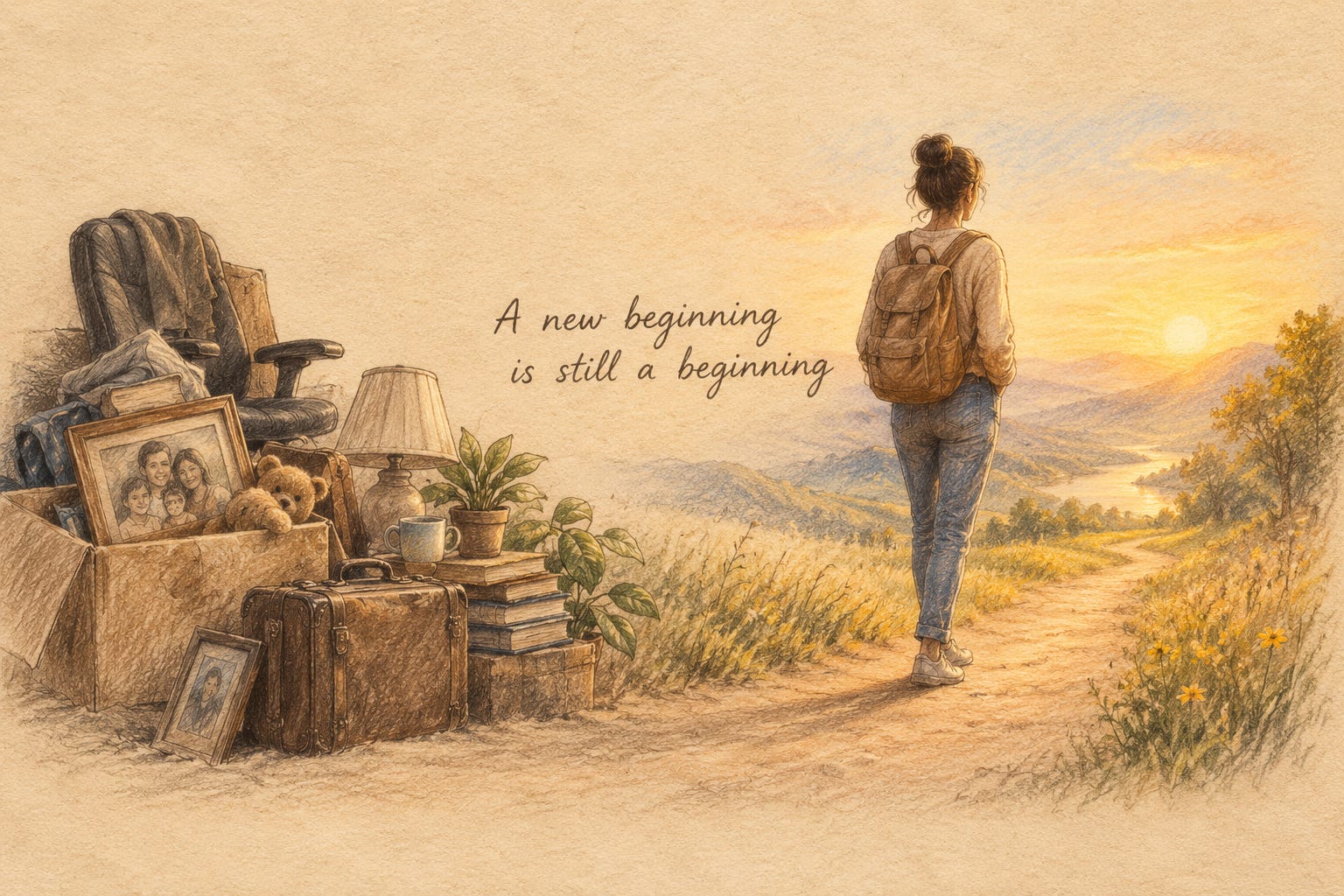
Imagine that, before entering this life, you stood at the edge of everything you had known.
Not at the edge of a particular place, but somewhere outside the ordinary limits of time, where a lifetime could be seen as a whole rather than as a collection of separate days.
Imagine looking ahead and seeing a life that begins with stability.
A home you know well.
People who know your name.
A family whose presence feels permanent.
Work that gives structure to your days.
Friends you expect to grow old beside.
Money that allows you to make plans without constantly wondering whether those plans are possible.
You do not begin this life expecting to lose these things.
You begin it expecting them to remain.
And perhaps that is important.
Because the life you are about to enter is not a story about someone who never had anything.
It is a story about having everything—and then, over time, watching one certainty after another disappear.
Imagine waking one morning with a life that feels ordinary in the best possible sense.
You know where you are going.
You know who will be there when you return.
You know how the bills will be paid.
You know which friends you can call without needing a reason.
You know which room is yours, which chair you always sit in, which familiar voices will answer when you walk through the door.
Then imagine that life beginning to change.
Not all at once.
First one thing.
Then another.
A loss you cannot prevent.
A door that closes.
A relationship that cannot survive what has happened.
A home that is no longer yours.
A bank balance that slowly becomes a source of fear.
People who once filled your ordinary days becoming distant, unavailable, or gone.
And eventually, perhaps, you reach a point where you can no longer recognise the person you were when this life began.
What would remain if almost everything you had used to define yourself disappeared?
Who would you become if you could no longer introduce yourself through your family, your work, your possessions, your achievements, your friendships or your place in the world?
And what if, in this imagined journey, losing everything was not the end of your life?
What if it became the beginning of another one?
For a little while, set aside whether such a journey could ever be chosen by a soul.
You do not have to believe it. You only have to imagine it.
And now, if you are willing, step into the life where everything you believe you need to be yourself will eventually be taken away.
Then stay long enough to discover what is left.
Live the Life
Imagine you are born into a family that is neither rich nor poor.
Your parents own a modest house on a street where children ride bicycles after school and neighbours know which cars belong to which families. There is a small garden at the back, a kitchen that always seems slightly too warm, and a dining table where everyone gathers even when nobody has much to say.
Your mother keeps things longer than she needs to.
Your father repairs things instead of replacing them.
A broken toaster can sit on the kitchen counter for three days while he takes it apart.
“Give me a minute.”
You know that means it may take an hour.
You grow up understanding that life is built from ordinary things.
A packed lunch. Clean clothes. A warm bed. School in the morning.
Your father’s footsteps on the stairs. Your mother’s voice calling you to dinner.
Nothing about it seems extraordinary. That is what makes it feel safe.
…
As a child, you do not think about losing your family.
You assume they will always be there.
You argue with your mother about homework.
You complain when your father makes you help in the garden.
You roll your eyes when he gives you advice you have heard ten times before.
When you are sixteen, you become convinced that nobody in your family understands you.
You spend more time outside the house.
You want independence. You want your own money. You want to leave the neighbourhood and discover a larger world.
One evening, after an argument, you hear your father say from the kitchen: “You’ll miss this place one day.”
You are standing halfway up the stairs. You do not turn around.
“I doubt it.”
He laughs.
“That’s what I thought too.”
You continue upstairs.
Years later, you will remember that conversation differently. At the time, it means nothing.
…
You leave home in your early twenties.
You find work.
Nothing glamorous.
Nothing that makes newspaper headlines.
But it pays reliably.
You rent a small flat, learn how to manage your own bills and discover the strange satisfaction of buying something with money you earned yourself.
You begin building a life.
You meet someone you love. The relationship is not perfect. You misunderstand each other. You have arguments. You sometimes wonder whether you are too different. But you keep choosing each other.
Eventually you move into a house together. It is not the house you once imagined. You love it anyway.
For the first time, you understand what your father meant. A home is not necessarily impressive. It is familiar. It holds your things. It knows your routines. It gives your life somewhere to return to.
…
Years pass.
You become established at work. You are trusted.
People come to you when something goes wrong because you know how to solve problems without making them larger than they need to be.
You receive a promotion. Then another. Your salary increases.
You save money. You begin making plans further than six months ahead.
You start thinking about retirement even if it seems impossibly far away.
Perhaps you have children. You learn that loving someone changes what fear feels like.
For a moment, nothing in your life feels uncertain.
You have your family.
You have your home.
You have your work.
You have your friends.
You have money in the bank.
You have a future you can imagine.
You do not know that this is the most secure your life will ever feel.
…
The first loss does not arrive like the end of the world.
It arrives as a phone call.
When your father dies, the world does not stop. But you discover something about grief that nobody had explained properly.
The world can continue while yours has changed completely.
…
Then your marriage begins to change.
It does not happen because either of you suddenly becomes a different person.
That would be easier to understand.
Instead, small distances appear.
You are tired. Your partner is tired.
You still love each other. But love and closeness are not always the same thing.
One evening, you sit across from each other at the kitchen table and talk to agree that you are only two people who have slowly become strangers while trying to hold everything together.
Eventually, you separate.
…
The day you leave the house is strangely ordinary.
You carry boxes downstairs and it is the first time you realise that sometimes hope is not confidence.
Sometimes it is continuing without confidence.
…
You rent a smaller place. You tell yourself it is temporary.
You will rebuild. You have rebuilt before.
You still have your job. You still have an income.
You still have friends. You still have your children.
You still have plans.
Then your company restructures.
Your position disappears.
…
The first month without work feels almost like freedom.
You sleep later. You organise the house. You update your CV. You apply for jobs.
You tell people: “I’m sure something will come up.”
And you believe it. Then another month passes. The savings account begins to fall.
You stand in the supermarket calculating what you can put back. You start understanding money differently.
When you had enough, money was invisible.
Now every purchase has a question attached to it.
Do you need it? Can you afford it?
…
A friend calls. “Come out tonight.”
You hesitate. “I can’t.” “You can. I’ll pay.”
You pause. “No. I don’t want you paying for me.”
There is silence.
Then: “It’s only dinner.”
You know that. But your pride has become entangled with your circumstances.
You begin turning down invitations.
Not because your friends have stopped caring.
Because you do not want to explain.
Eventually they stop asking as often.
A friendship that once felt permanent becomes occasional messages.
…
Your mother dies a few years later.
This time you are older. You understand death better. That does not make it easier.
You realise you have become the adult you once thought your parents were.
And now there is nobody above you to call.
…
Your children grow older. This is another kind of loss.
Not the loss of love. The loss of proximity. They leave home.
You learn that being needed and being loved are not the same thing.
…
You wake on Saturday and realise nobody expects you anywhere.
You make coffee for one.
You sit at the table.
For a while, you miss the noise.
Then you notice something unexpected.
You are beginning to hear yourself think.
…
Your finances become worse before they become better.
The small savings you had left disappear.
You become skilled at making your circumstances appear less difficult than they are.
If someone asks where you live, you change the subject.
If someone asks about work, you say: “I’m figuring things out.”
You become uncomfortable when people offer help.
You think accepting help means you have failed.
…
You take whatever work you can find.
Temporary jobs. Part-time work. Practical work. Work you once believed was beneath you. At first you resent it. Then you discover something.
Nobody at this job knows who you used to be.
They only know whether you arrive on time.
Whether you help when someone needs it.
Whether you treat people decently.
You begin to notice people differently.
The older woman who always counts her coins.
The man who never buys lunch.
The young worker who apologises whenever he makes a mistake.
The cleaner who stays late because she cannot afford not to.
You recognise something in them.
Their dignity.
You begin to understand how easily a person can be reduced to what they have.
And how painful that can be.
…
Your relationship with your former partner changes too.
Time has softened some things.
Not everything.
There are still subjects you avoid.
There are still regrets.
But one evening, you talk for a long time.
Your former partner says:
“I think we were both trying so hard to keep everything together.”
You nod.
“We didn’t know what we were doing.”
“No.”
You both laugh.
For the first time, there is no need to decide who was right.
You have both lived long enough to understand that sometimes two people can hurt each other without either one being a bad person.
That understanding arrives late.
But it arrives.
…
Years pass.
You rebuild, but not in the way you once imagined.
You never return to the same level of wealth.
You do not buy another large house.
You do not recover the career you once had.
Some friendships never return.
Your family changes shape.
Your children have their own lives.
Your old identity becomes something you remember rather than something you inhabit.
And yet your life becomes fuller in places you had not expected.
You become the person people call when they need someone who will listen without immediately giving advice.
You learn how to sit with another person’s embarrassment without making them feel embarrassed.
You stop assuming that someone who is struggling has made poor choices.
You stop assuming that someone who is successful has an easy life.
You begin noticing the stories hidden behind ordinary faces.
…
In your later years, you move into a smaller home.
You spend more afternoons walking.
You know your neighbours.
You help someone carry shopping.
You occasionally receive a phone call from one of your children.
Sometimes you see your grandchildren.
…
One afternoon, your youngest child sits beside you.
You are both looking through old photographs.
There is one of your first house.
You look at it for a long time.
“That was a good time,” your child says.
You nod.
“It was.”
Then you look at another photograph.
A smaller home.
A different period of your life.
You smile.
“That was a good time too.”
Your child looks at you.
“Even though everything went wrong?”
You think about the question.
“Not everything went wrong.”
“What do you mean?”
You look down at the photographs.
“I lost a lot.”
You pause.
“But I also found out what I could live without.”
Your child says nothing.
You continue.
“And what I couldn’t.”
…
You grow older. Your body becomes less reliable.
You move more slowly.
Stairs become difficult.
You forget names occasionally.
You become annoyed with yourself.
Then you laugh about it.
…
Some losses still hurt.
There are people you wish you could speak to again.
There are choices you would make differently.
There are apologies you wish had happened sooner.
There are years you would gladly revisit.
But there are also things you no longer carry.
The need to impress.
The fear of appearing unsuccessful.
The belief that security can be guaranteed.
The assumption that having more means being more.
The idea that a person can be measured by what remains in their hands.
…
Near the end of your life, you sit beside a window.
It is an ordinary afternoon.
There is nothing remarkable about the room.
You can hear traffic outside.
You look around.
This is not the life you expected when you were young.
You had imagined a long career.
A stable home.
A family that would remain close.
Old friends around a table.
Enough money to feel secure.
You had believed that a good life meant keeping these things.
Now you understand that a life can be good even when many of the things you hoped to keep have disappeared.
You realise never lost yourself completely.
You lost versions of yourself.
The successful version. The secure version. The admired version. The version who believed the future could be controlled.
One by one, those versions fell away.
Something quieter remained… Only the sense that you had become more familiar with being human.
…
Your breathing becomes slower.
There is no dramatic final moment.
No revelation that explains everything.
No voice telling you what your life meant.
There is only the life you lived.
The things you loved.
The things you lost.
The things you became.
And as the imagined lifetime draws to its natural end, you are left with the strange simplicity of it.
You began with a full house.
You spent years trying to keep everything.
And eventually, you learned that a life cannot be measured by how much it manages to hold onto.
You leave the world with far fewer possessions than you once believed you needed.
But perhaps with a larger understanding of what it means to belong here.
Why This Life?
If you step back from the life you have just lived, a difficult question remains.
Why this life? Why begin with security if so much of that security will eventually disappear?
Why know the comfort of family before knowing what it is to live without the people who once made home feel permanent?
Why build a career, earn money, own a house and develop an identity around stability if circumstances will eventually strip so much of it away?
Perhaps that is precisely where this imagined life becomes interesting.
Not because losing everything is somehow good.
It isn’t.
There is no need to romanticise grief, financial hardship, divorce, loneliness or the death of people you love. Some experiences hurt because they hurt. Some losses leave wounds that never become beautiful lessons.
But perhaps a soul could choose a life in which those losses become unavoidable because there are forms of understanding that cannot be reached while everything remains secure.
You could read about impermanence. You could understand it intellectually. But knowing that everything changes is different from having your own life demonstrate it to you, piece by piece.
In this imagined lifetime, you first experience the ordinary human assumption that what surrounds you will continue to surround you.
Then life begins removing those assumptions.
Perhaps the soul chose this because it wanted to understand what remains when permanence is no longer available.
There is another way of looking at this question: perhaps what hurts most when something disappears is not the thing itself, but the sense of who we were while we had it. We become attached to the roles, relationships, possessions and circumstances that give our lives a certain shape, until losing them can feel like losing part of ourselves. This is explored from another angle in You Are Not Losing Things by Practical Stoic Advice, which asks what happens when we stop treating the things we love as things we are guaranteed to keep.
…
Perhaps the loss of your loved one teaches something fundamental for our human life.
You discover that love does not depend on someone remaining physically present.
You lose their voice, routines, advice, and presence around you. But the relationship does not become meaningless because it ends.
Instead, you carry parts of it forward.
The memory of sitting beside them when needed.
Perhaps this is one of the reasons a soul might choose to experience loss: to discover that something can end without becoming worthless.
You learn that an ending does not erase what came before it.
…
Then there is the loss of your marriage.
That loss is different.
You discover that sometimes love can exist alongside incompatibility, exhaustion and distance.
Perhaps a soul could choose this experience to understand that not every relationship is meant to last forever in its original form.
You learn something difficult about attachment.
You can love someone and still have to let them go.
You can regret the way something ended without believing the entire relationship was a mistake.
You can accept responsibility for your part without carrying all the blame.
And perhaps, eventually, you discover forgiveness without requiring the past to become different.
That is a particular kind of wisdom.
It could not have been learned from a perfect relationship.
…
Then your work disappears.
This loss reaches somewhere different.
Your career had quietly become part of your answer to the question, Who are you?
Perhaps a soul would choose this because identity is one of the hardest things to examine while life keeps confirming it.
When people respect your position, it is easy to confuse respect for the role with respect for the person.
When money arrives regularly, it is easy to mistake financial security for personal security.
When your work gives your days structure, it is easy to believe that without the work there may be less of you.
But unemployment forces a different question.
Who are you when nobody needs your professional skills?
Who are you when there is no title beside your name?
Who are you when your contribution cannot be measured by a salary?
Perhaps this imagined life allows the soul to discover that identity can survive the collapse of status.
…
Money teaches another lesson.
Perhaps this is one of the most uncomfortable parts of the journey because financial insecurity changes ordinary decisions.
You discover that poverty is not an abstract condition.
It reaches into choices, relationships, dignity and the way you see yourself.
And because you once knew financial stability, you can feel the contrast.
Perhaps that contrast is important.
You learn that the person counting coins in front of you is not fundamentally different from the person who once walked confidently through an expensive shop.
Circumstances can change.
A person can fall from security into uncertainty without becoming less worthy.
That understanding may be difficult to acquire from the outside.
You may need to live close enough to vulnerability to recognise it.
Perhaps the soul chooses that proximity not because suffering is desirable, but because compassion sometimes grows from experiences that remove the distance between you and them.
…
Then there is the loss of friendship.
It is easy to imagine that people leave because they stop caring.
Sometimes they do. But sometimes life pulls people in different directions.
You begin to see that friendship is affected by circumstances more than you once realised.
When you are busy, successful and available, maintaining friendships can feel effortless.
When you become ashamed of your situation, you withdraw.
When your friends become busy with their own families, their attention changes.
Nobody has necessarily decided to abandon you. The connection simply becomes harder to maintain.
Perhaps this teaches you something about loneliness that could never be learned from being surrounded by people.
You begin to distinguish solitude from rejection.
You learn that being alone does not necessarily mean being unloved.
And you learn something else that may matter even more: you cannot always know what is happening inside another person’s life.
The friend who stopped calling may have been struggling too.
The person who seemed distant may have been overwhelmed.
The person who appeared successful may have been frightened behind closed doors.
Perhaps this life teaches you to leave room for stories you cannot see.
…
Your children growing away from you brings yet another form of loss.
Perhaps a soul could choose this experience to discover that love does not require possession.
You learn to allow people you love to become fully themselves.
You learn that being needed is not the highest form of being loved.
You learn that sometimes the most loving thing you can do is step back.
This is not a lesson about losing your children. It is a lesson about allowing love to change shape.
…
And perhaps the greatest loss in this imagined life is not your family, career, money or home.
Perhaps it is the gradual loss of the person you thought you had to be.
You lose the successful version of yourself.
You lose the secure version.
You lose the person who knew exactly where life was heading.
You lose the person who believed that careful planning could protect you from uncertainty.
At first, that feels like failure.
Later, it begins to look different.
You discover that some identities are useful for a time and then become too small.
Perhaps the soul chooses a life of repeated endings because it wants to become less dependent on those identities.
Perhaps the deeper movement is from What do I have? toward Who am I when what I have changes?
And perhaps that question is worth an entire lifetime.
…
Look again at the person you became by the end of this life.
You did not become wise because suffering magically improved you.
You became more understanding because you had opportunities to see things you could not previously see.
You knew what it was like to have enough.
Then you knew what it was like not to have enough.
You knew what it was like to be needed.
Then you knew what it was like to be alone.
You knew professional respect.
Then you knew what it felt like to be overlooked.
You knew the security of a home.
Then you knew the vulnerability of not being certain where you belonged.
You knew the comfort of family.
Then you discovered that love can continue even when proximity cannot.
Perhaps that range of experience was the point.
The ability to understand that no single circumstance tells the whole story of a human being.
Perhaps a soul choosing this life would not be choosing to lose everything.
Perhaps it would be choosing to discover what cannot be lost.
Perhaps this particular life was to teach you how to remain yourself when you cannot.
Bringing These Lessons Into This Life
After living through that imagined lifetime, it may be difficult to look at loss in quite the same way.
You have watched a life begin with the things most people hope will remain.
You have also watched those things disappear at different points, sometimes through death, sometimes through circumstance, sometimes through choices that nobody intended to make.
And perhaps the first thing this changes is the way you look at your own certainty.
You may have things in your life today that feel permanent.
You may not consciously think, I will have this forever. But somewhere underneath your everyday thoughts, you may live as if you will.
The imagined life reminds you that almost everything we build our identity around is capable of changing.
That does not mean you should become afraid of losing it.
Perhaps it means you can appreciate it while it is here.
…
And perhaps the most important lesson to carry back is about beginning again.
The imagined life did not rebuild itself by recovering everything it had lost.
It rebuilt by accepting that the old version of life was no longer available.
Sometimes when something ends, you spend enormous energy trying to recreate what existed before.
You want the same relationship.
The same career.
The same financial security.
The same friendships.
The same version of yourself.
But perhaps beginning again asks something different.
Not: How do I get my old life back?
But: What kind of life can I build now?
Those are very different approaches. One keeps you looking backwards. The other allows the future to exist.
…
Perhaps this is where the imagined soul’s journey becomes relevant to ordinary life.
Most people will not lose everything in the exact way described here.
But almost everyone experiences some form of beginning again.
And perhaps sometimes meaning often enters life through losses—not as a grand revelation, but through the decision to keep living after the future you expected has disappeared.
…
Perhaps your soul did not come here to protect you from every ending.
Perhaps, it came with the possibility that you would encounter change and discover how much of yourself could remain intact through it.
Because human beings are capable of becoming more understanding through what they live.
And perhaps that includes you.
You may never know what another person’s soul came here to experience.
You may never know whether their difficulties have meaning.
You may never know whether your own losses were chosen, accidental, unavoidable or simply part of the uncertainty of being alive.
You do not need to know.
Perhaps it is enough to recognise that every life contains a story you cannot fully see.
And once you recognise that, judgement becomes harder.
Comparison becomes less convincing.
Compassion becomes easier.
You may begin to understand that a meaningful life teaches you how to love what you have, release what you cannot keep, and remain open to what can still begin.
Perhaps your soul didn’t come here to have an easy life. Perhaps it came to have a meaningful one.
And perhaps meaning is not found in how much remains in your hands at the end. Perhaps it is found in what you have learned to see while you are still here.
Closing Reflection
The most unsettling part of imagining this life is that you can recognise pieces of it in your own.
And maybe, for now, you can hold the possibility that a life can contain loss without being a failed life.
And that the things you lose can matter enormously without being the things that ultimately define you.
If you imagine that every soul might travel through many different kinds of human experience, then perhaps no life can be measured fairly from the outside.
You cannot know what another person came here to understand.
You cannot know which losses shaped them, which fears they are carrying, or how hard it was for them to begin again.
You cannot even know what your own life may still be teaching you… right now…
So perhaps the question is not whether you can prove that every experience was chosen.
Perhaps the more useful question is simply this:
If you could look back on your entire life and see every loss, every ending, every beginning, and every person you encountered as part of your larger journey, what lessons would you realise you had learned?
Continue Your Journey with Wisdom Library
Become part of the community and start receiving exclusive content.
Explore further with a selection of related articles.
Discover a collection of products I personally recommend to support your journey.
If this article meant something to you, you can support Wisdom Library with a contribution, allowing the publication to grow and continue creating thoughtful content. Thank you for being here.
A few more from me…


Thank you…
Alexandra, I appreciate that you don't try to turn every loss into a beautiful lesson. Some things hurt, and nothing can make them fair. But I do believe we can discover parts of ourselves we never knew existed when life forces us to begin again. Perhaps what matters isn't whether we chose those experiences, but what we choose to do afterward.