

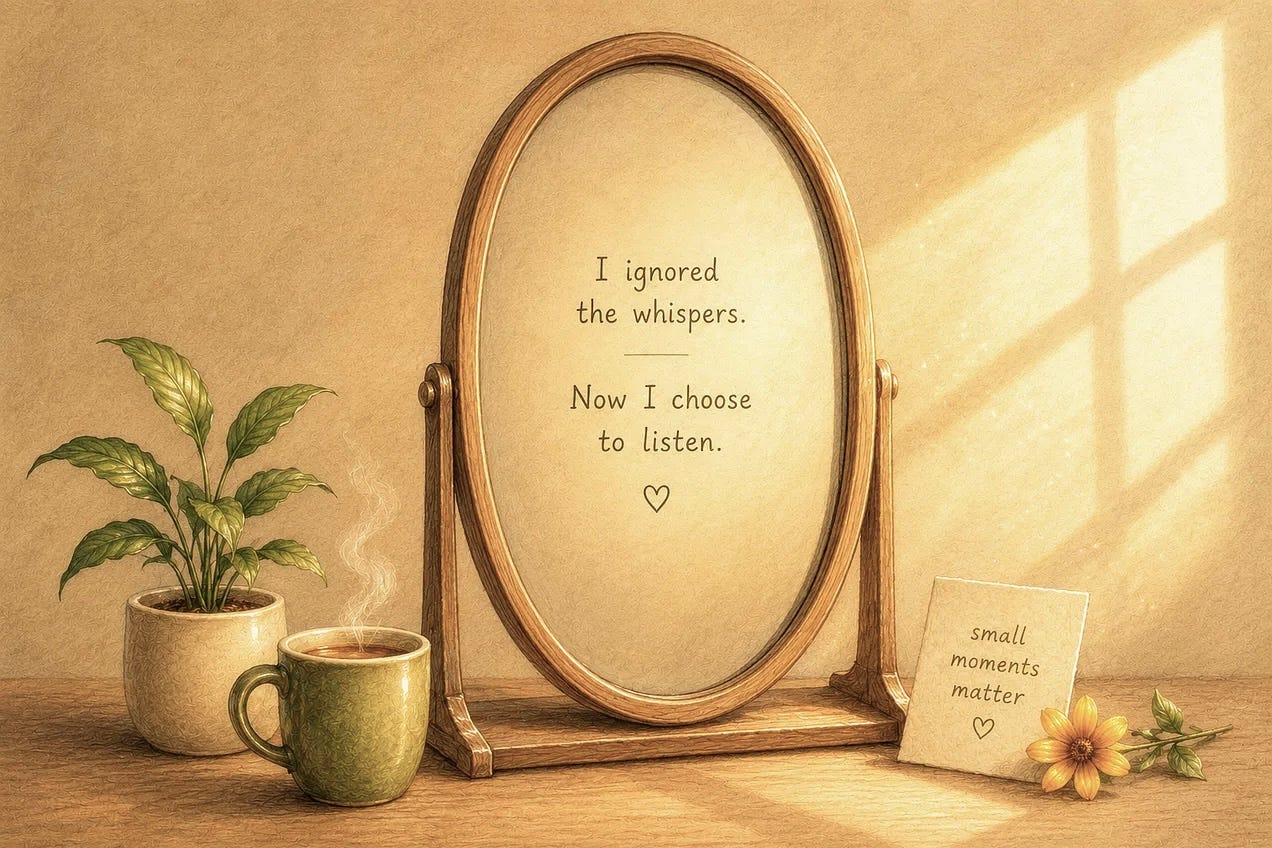
There are moments that pass almost unnoticed. You realise you’ve been sitting in the same position for hours because your back reminds you when you finally stand up. You reach for another coffee before you’ve finished the glass of water sitting beside it. You promise yourself you’ll go to bed earlier tonight, just as you promised yourself yesterday. None of these moments seems important. They’re so ordinary that they barely register, easy to dismiss as part of another busy day.
But perhaps that’s exactly why they matter. Most of our lives aren’t shaped by the occasional big decision or dramatic turning point. They’re shaped by the conversations we never have with ourselves while moving through ordinary days. Then, without warning, something interrupts that routine. Not because life has fallen apart, but because a question quietly surfaces that has been waiting for your attention for longer than you realised.
When did I stop paying attention to myself?
The Reflective Conversation
I: I’ve been thinking about how often I ignore myself.
Soul: What made you notice?
I: Nothing dramatic. I wasn’t ill. I wasn’t overwhelmed. I wasn’t standing at some major crossroads. I was making a cup of tea when I realised I’d spent the whole morning responding to emails, solving problems and thinking about everyone else’s priorities. It suddenly occurred to me that I hadn’t once stopped to ask how I was doing.
Soul: How did that feel?
I: Embarrassing.
Soul: Why embarrassing?
I: Because I realised I would never treat someone I care about that way. If a friend forgot to eat, I’d remind them. If they looked exhausted, I’d tell them to slow down. If they kept saying yes to everything, I’d ask whether they needed a break. Yet somehow, when it’s me, those questions never seem urgent enough to ask.
Soul: When did you decide you deserved different treatment?
...
I: I don’t remember deciding. I think it happened so gradually that I never noticed. There was always something more important to finish first.
Soul: And when did “first” quietly become “always”?
...
I: I don’t know. Maybe because there was always another deadline. Another responsibility. Another reason why today wasn’t the right day to stop. I kept believing there would be more space tomorrow.
Soul: Has tomorrow ever arrived in the way you imagined?
...
I: No. Every tomorrow seems to arrive carrying another list. I finish one task, and before I’ve even acknowledged it, I’m already thinking about the next. Sometimes I work towards something for weeks, and when it’s finally done, I barely allow myself to enjoy it before I’ve replaced it with another goal.
Soul: Why?
...
I: Because stopping feels uncomfortable. It’s as though there’s a voice saying, “Don’t relax yet. You’ve probably forgotten something.”
Soul: And what happens if you ignore that voice?
I: I don’t know. I don’t think I’ve ever tried.
Soul: Isn’t that interesting? You’re certain rest would make you fall behind, yet you’ve never tested whether that’s true. You’ve only believed it.
...
I: I hadn’t thought of it that way. I’ve treated that belief as if it were a fact.
Soul: Many of the rules we live by were never examined. They were repeated until they sounded like truth.
I: So perhaps the list isn’t what controls me. Perhaps it’s the belief that I have to earn the right to stop.
Soul: What do you think you have to earn?
I: Rest. Peace. The feeling that I’ve done enough.
Soul: And have you ever reached enough?
...
I: No. Every time I think I have, the definition changes.
Soul: Then perhaps you’ve been chasing something that was never designed to be caught.
...
I: That’s difficult to admit. Because it means I’ve spent years waiting for permission that was never going to arrive.
Soul: Permission from whom?
I: I don’t know anymore. Maybe from myself. Maybe from the version of me that believes life has to be fully under control before I can relax.
Soul: Does that version of you exist?
I: No. I don’t think anyone reaches that point. Life keeps changing.
Soul: Then perhaps you’re asking yourself to meet a condition that no human being ever could.
...
I: Why is it so easy to notice everyone else’s needs?
Soul: Because they’re visible. Your own often arrive quietly. A little less patience. A heavier body. A shorter answer than you intended to give. A tiredness you explain away because everyone else seems tired too.
I: I usually tell myself I’m coping.
Soul: Are you?
I: Most days.
Soul: Is coping the life you wanted, or merely the life you’ve become accustomed to?
...
I: There’s a difference, isn’t there?
Soul: A very important one. Coping asks, “How much more can I carry?” Living asks, “What kind of life am I creating while I carry it?”
I: I don’t think I’ve been asking that second question.
Soul: Why not?
I: Because it feels less practical. The first one has an obvious answer. Keep going. The second asks me to think differently.
...
Soul: Have you confused endurance with strength?
I: I think I have. I’ve always admired people who push through. People who never complain. People who keep going no matter what.
Soul: What do you imagine their inner conversations sound like?
...
I: I’ve never wondered. I suppose I assumed they weren’t struggling.
Soul: Or perhaps they became very good at hiding it. We often compare our private experience with someone else’s public appearance. That comparison is rarely fair.
I: You’re right. I see what people accomplish. I rarely see what it costs them.
Soul: And because you don’t see the cost, you expect yourself to achieve the same results without acknowledging your own.
...
I: I’ve never thought of it like that. Maybe I’ve been measuring my life against incomplete information.
Soul: Most comparisons are built that way.
...
I: What do you think I’ve been asking of myself all these years?
Soul: You tell me.
I: More. Always more. More discipline. More patience. More productivity. More resilience. More availability. Every time I reach one expectation, another appears.
Soul: And what have you offered yourself in return?
...
I: That’s a much harder question… I can tell you exactly what I’ve expected from myself. I can list the standards. The routines. The responsibilities. But when I try to think about what I’ve offered myself... I’m not sure.
Soul: Stay with that. Don’t rush past it.
I: I suppose I’ve offered myself criticism. Correction. Pressure. Whenever I succeed, I move on quickly. Whenever I fall short, I remember it for days. I’ve always believed that’s how people improve.
Soul: Has it made you kinder?
I: No.
Soul: Has it made you happier?
I: No.
Soul: Then what has it given you?
...
I: It kept me moving. But it also made it difficult to enjoy where I arrived.
Soul: That’s an expensive price to pay for progress.
...
I: I’ve always worried that if I became kinder to myself, I’d become lazy.
Soul: Have you ever encouraged another person through kindness?
I: Yes.
Soul: Did they stop growing?
I: No... Usually they became more confident.
Soul: Then why do you believe you’re the one person kindness would weaken?
...
I: Maybe because I’m afraid fear has been doing more of the work than I’d like to admit.
Soul: Fear can be an effective motivator. For a while. The question is whether you still want it to be your companion.
I: I don’t. I’m just not sure what replaces it.
Soul: Curiosity. Respect. Purpose. Those tend to last longer.
...
I: Sometimes I wonder whether I’ve spent more time trying to improve myself than understand myself.
Soul: Which one feels safer?
I: Improvement. There’s always another book. Another course. Another habit. Understanding feels different.
Soul: How?
I: It asks me to stop long enough to notice why I keep chasing improvement in the first place. And I’m not always sure I want the answer.
Soul: Why not?
...
I: Because I’m afraid I won’t like what I find. What if I discover that some of the things I’ve called discipline are actually fear? What if some of my ambition has been driven by proving something rather than expressing something?
Soul: Would knowing that diminish what you’ve achieved?
I: No. But it would change the story I’ve been telling myself.
Soul: And is changing the story always a loss?
...
I: I suppose not. Sometimes it’s the beginning of understanding.
Soul: Exactly. You don’t lose yourself by seeing yourself more clearly. You lose the version that was never entirely true.
...
I: Can I ask you something?
Soul: Of course.
I: Why do I keep waiting until something feels wrong before I pay attention? Why don’t I notice sooner?
Soul: Because discomfort whispers before it shouts. Most whispers are easy to ignore.
I: I tell myself it’s nothing. That I’m only tired. That this week has been unusually busy. That next week will be different.
Soul: And how many “unusually busy” weeks have become years?
...
I: More than I’d like to admit.
Soul: Why do you think that is?
I: Because if I admit something small isn’t working, I might have to change something bigger.
Soul: Such as?
I: The pace I’ve accepted. The expectations I’ve placed on myself. The way I organise my days. Maybe even the way I measure whether a day has been successful.
Soul: That’s why the small signals matter. They aren’t asking you to panic.
They’re inviting you to pay attention while change is still possible....
I: I think I’ve spent years waiting for life to interrupt me.
Soul: What do you mean?
I: Part of me expected that if I ever pushed too hard, my body or circumstances would eventually force me to stop. Almost as if that would make resting acceptable.
Soul: Why does rest need permission?
I: Because if I choose it myself, it feels optional. If it’s forced upon me, it feels justified.
Soul: So you’ve trusted exhaustion more than your own judgement.
...
I: That’s exactly what I’ve done. I wait until I can’t ignore it anymore.
Soul: Imagine treating every relationship that way. Only listening once someone begins shouting. How long do you think those relationships would last?
I: Not very long.
Soul: Then why should the relationship with yourself be any different?
...
I: I’ve never thought of my relationship with myself in those terms. I usually think about habits. Goals. Performance. Not a relationship.
Soul: Yet isn’t it the longest relationship you’ll ever have?
I: It is.
Soul: How would you describe it?
...
I: Demanding. Productive. Impatient. Sometimes encouraging. Often critical. Rarely curious.
Soul: Which of those would you want to change first?
I: The lack of curiosity.
I think I’ve spent too much time assuming I already know myself.
Soul: Do you?
I: Apparently not. Otherwise I wouldn’t be surprised by these questions.
...
Soul: What do you think curiosity sounds like?
I: Maybe... “What do I need today?” Instead of... “How much more can I get done today?”
Soul: That’s one example. Can you think of another?
I: Instead of asking why I’m not more disciplined... I could ask why something feels difficult. Instead of judging myself for being tired... I could ask what has been draining me.
Soul: Notice the difference? One question demands. The other listens.
...
I: Listening feels slower.
Soul: Does slower always mean worse?
I: No… Some of the most meaningful conversations I’ve had weren’t rushed.
Soul: Why should the conversation with yourself be any different?
...
I: I think I’ve mistaken speed for progress. If I solve something quickly, I feel productive. If I spend time reflecting, I sometimes feel as though I’m wasting it.
Soul: Yet how many hours have you spent repeating patterns you never stopped to examine?
...
I: More than I can count.
Soul: Reflection often saves time that endless repetition cannot.
...
I: Can people change without becoming completely different?
Soul: What do you mean?
I: Sometimes self-development sounds like becoming another person. Someone calmer. Healthier. More balanced. More patient. Almost as though the current version of me needs replacing.
Soul: Do you believe that?
I: I’m beginning not to.
Soul: Good. Because growth isn’t always about becoming someone else. Sometimes it’s about removing the habits that stopped you being yourself.
...
I: That’s a kinder way of looking at it.
Soul: Is it kinder... or more accurate?
...
I: Maybe both. I’ve spent years trying to build a better version of myself. Perhaps I should have spent more time getting to know the person who was already here.
...
Soul: Tell me something. When was the last time you thanked yourself?
I: Thanked myself? I don’t think I ever have.
Soul: Why not?
I: It feels strange. Almost self-indulgent.
Soul: Does thanking someone always mean they’re perfect?
I: No.
Soul: Then why should it mean that when the someone is you?
...
I: I suppose it doesn’t.
Soul: Think about everything you’ve carried. The responsibilities. The disappointments. The things you’ve learned. The mistakes you’ve recovered from. The mornings you got up when you didn’t feel like it. The conversations no one else knows you’ve had inside your own mind. Have you ever acknowledged any of that?
...
I: Not in those words. I usually move on to the next thing.
Soul: Perhaps that’s why the next thing always feels so urgent. Nothing has been allowed to become enough before it’s replaced.
...
I: I think I’ve been waiting for some future version of myself to deserve appreciation.
Soul: And what happens when you become that version?
I: I’ll probably create another one.
Soul: Exactly. There will always be another horizon if your value depends on reaching it.
...
I: Then maybe this isn’t about becoming a different person. Maybe it’s about becoming more present with the person I already am.
Soul: What would change if you did?
I: I think I’d notice more. Not just when something is wrong. I’d notice when something feels good. When I have more energy. When a conversation leaves me lighter. When I laugh more easily. When I finish work feeling satisfied instead of immediately searching for the next task.
Soul: Why does that matter?
I: Because I’ve realised I pay far more attention to what’s missing than to what’s already here.
...
Soul: And where attention goes... life often follows.
...
I: I don’t think this conversation has been about looking after myself. Not really.
Soul: What do you think it’s been about?
...
I: Learning to stop treating myself like a project that’s never finished. And beginning to treat myself like a person worth listening to.
Soul: Which of those sounds more likely to keep you company for the rest of your life?
I: The second one. It feels less exhausting.
Soul: Then perhaps that’s where you begin. Not by changing everything. But by paying attention before life has to ask twice.
Reflection
Perhaps you recognised yourself somewhere in this conversation. Not because you’ve stopped caring for yourself, but because you’ve become used to putting your own needs further down the list. It’s something many of us do without even noticing. We become so focused on what needs our attention that we rarely stop to ask how we’re doing ourselves.
Maybe the real question isn’t whether you’re taking good enough care of yourself. Maybe it’s whether you’ve been paying attention.
You don’t have to change everything tomorrow or create another list of habits to follow. Sometimes the smallest moments of awareness are enough to change the direction of a day. You notice you’re rushing. You notice you’re more tired than you realised. You notice you’ve been carrying tension for longer than you thought.
Those moments won’t solve every problem, but they offer something just as valuable - the chance to respond instead of continuing on autopilot.
Perhaps caring for yourself begins there. Not with perfection or another attempt to become someone different, but with the willingness to notice yourself a little sooner than you did yesterday.

Questions to Sit With
What have I accepted as “normal” that deserves to be questioned?
Which part of my life keeps asking for my attention, even though I keep telling myself I’ll deal with it later?
If I stopped measuring my worth by what I accomplish, what else might I begin to notice about myself?
One Small Practice
At the end of each day this week, before reaching for your phone or starting the next task, pause for one minute.
Ask yourself three simple questions:
What gave me energy today?
What quietly took energy away?
What is one small thing I can do tomorrow that honours what I’ve noticed?
Don’t try to change everything.
Practice becoming someone who notices.
The rest can grow from there.
Closing Thought
I: Do you think I’ll remember this conversation tomorrow?
Soul: Maybe.
I: And if I don’t?
Soul: Life has a way of asking the important questions more than once.
I: I hope next time I listen sooner.
Soul: So do I
If this article meant something to you, buying me a coffee is a simple way to support my work. Every contribution helps Wisdom Library continue to grow. Thank you for being here. 💛
The conversation that matters most is often the one we postpone with ourselves.
Not because we have nothing to say, but because genuine listening asks us to slow down before life forces us to.
Sometimes returning to ourselves is less about becoming someone new than remembering who has been waiting there all along.
Thank you for this beautiful reflection.
This is powerful. These internal “soul conversations” are so important to have.
Reading your dialogue reminded me of the types of conversations I would have with clients back when I was coaching. Truly though, if you can make time to sit in stillness and hear your soul’s voice, your spirit and ego can engage in a very beneficial dialogue together.
Very helpful approach. Thank you, Alexandra.