

Wisdom Library grows with the support of its readers.
Your paid subscription supports my research and writing, while giving you access to exclusive resources designed to broaden your perspectives and deepen your understanding of life.
Thank you for being part of my community.
Most days don’t begin with a crisis.
They begin with a choice so ordinary we barely notice it.
The alarm rings. We reach for the phone. We promise we’ll eat later. We rush through the house looking for keys, checking emails before we’ve even looked out of the window. By lunchtime we wonder why we’re tired, impatient, or unable to concentrate, as though those feelings arrived without an invitation.
We often imagine that the big decisions shape our lives.
But perhaps the smallest ones introduce us to ourselves more often than we realise.
The Reflective Conversation
I: It happened again today.
I told myself I’d make time before work. Not much. Ten minutes would have been enough. Instead I answered one message, then another. I thought I’d deal with one small task before sitting down, and somehow the morning disappeared.
By the time I noticed, I was already living inside everyone else’s priorities.
Soul: Did the morning disappear?
Or did you give it away piece by piece?
I: That sounds harsher than it felt.
Nothing terrible happened. There wasn’t an emergency. I was only being responsible.
Soul: Responsible to whom?
I: Work. People waiting for replies. The list that always seems longer than yesterday’s.
Soul: And where were you on that list?
I: That’s the thing. I don’t think I was.
...
Soul: You speak about caring for yourself as though it belongs at the end of the day. Why?
I: Because that’s when everything else is finished.
Soul: Is everything ever finished?
I: No.
There’s always another email, another load of washing, another decision waiting. Even when I finish one thing, another appears before I’ve had time to notice the first one is done.
Soul: Then you’ve attached your own care to a finish line that keeps moving.
I: I hadn’t thought about it like that.
I suppose I have.
I keep telling myself, “Later.”
Later, when work settles down.
Later, when the house is tidy.
Later, when life becomes less busy.
The strange part is I’ve been saying “later” for years.
Soul: What makes you believe that the future version of you will suddenly have more permission than the present one?
I: Maybe because I imagine she’ll have everything under control.
Soul: Have you ever met her?
I: No.
Soul: Yet you’ve trusted her with every kindness you refused yourself today.
...
I: I don’t think I refuse myself on purpose.
It doesn’t feel deliberate.
Soul: Most important habits aren’t deliberate.
Think about how often you put your phone in the same place without thinking. Or walk the same route through the supermarket. Repetition removes the need to decide.
The same happens with how you treat yourself.
After enough repetition, postponing your own needs begins to feel normal.
Not because it’s healthy.
Because it’s familiar.
I: That’s uncomfortable.
It makes me wonder how many things I call personality are actually habits I’ve never questioned.
Soul: More than you probably imagine.
I: So how do I tell the difference?
Soul: Ask yourself one question.
“If someone I loved treated themselves the way I treat myself, would I think this was normal?”
I: Probably not.
If a friend told me they skipped every chance to rest because they hadn’t earned it yet, I’d tell them they didn’t need permission.
Soul: Yet your own voice speaks differently.
Why do you believe yourself less worthy of the advice you freely give others?
I: I don’t know.
Maybe because I think I should be stronger.
Maybe because I believe I should cope.
Maybe because everyone else seems to manage.
Soul: Do they?
Or have you confused appearances with reality?
...
I: It’s difficult not to compare.
You see people who seem organised, healthy, successful.
They exercise.
They cook.
They meditate.
They have hobbies.
Meanwhile I’m wondering how the day disappeared again.
Soul: You compare your ordinary day with someone else’s carefully selected moments.
Do you think that’s a fair comparison?
I: Probably not. But it still affects me.
It makes ordinary care feel like another achievement I haven’t unlocked yet.
Soul: There it is.
I: What?
Soul: You’ve turned care into another performance.
You don’t see it as something every human being deserves.
You see it as another reward for being productive enough.
I: I hadn’t realised I was doing that.
Soul: Think about the language you use.
“I deserve a break.”
“I’ve earned a good meal.”
“I’ll relax once I’ve finished.”
Notice the pattern?
Everything kind comes after proving yourself.
I: You’re right.
I don’t say, “I’ll breathe because I’m alive.”
I say, “I’ll breathe after I’ve been useful.”
Soul: And usefulness has become the price of existence.
...
I: Where does that come from?
Soul: Where do you think?
I: Childhood, perhaps.
School rewarded achievement.
Work rewards achievement.
Even compliments often sound like performance reviews.
“You’re so productive.”
“You’re always reliable.”
“You work so hard.”
People rarely say, “I’m glad you took care of yourself today.”
Soul: We often celebrate what others give us.
Less often what they give themselves.
I: So we learn what earns approval.
Soul: Yes.
Then one day we continue the pattern without anyone asking us to.
The outside voice becomes our own.
I: That’s unsettling.
Because it means nobody is telling me to rush anymore.
I’m telling myself.
Soul: Exactly. The hardest expectations to notice are the ones we’ve adopted as our own.
...
I: Can I admit something that feels embarrassing?
Soul: Of course.
I: Sometimes I make ordinary things unnecessarily complicated.
I’ll spend twenty minutes researching the perfect way to do something instead of spending five minutes actually doing it.
Whether it’s organising my week, exercising, reading, or making lunch, I convince myself I need the ideal version.
Then I run out of time altogether.
Soul: Perfection has an interesting disguise.
People often mistake it for high standards.
Sometimes it’s only another way of postponing life.
I: Because if it can’t be perfect, I wait.
Soul: Yes. Waiting feels safer than beginning imperfectly.
I: But beginning imperfectly would probably improve my life more than endless planning.
Soul: Which version of you receives more care?
The imaginary perfect one?
Or the real one standing in the kitchen on an ordinary day?
I: The imaginary one.
She’s always getting tomorrow’s promises.
Today’s version gets excuses.
...
Soul: Imagine someone you care about.
Not on their birthday.
Not after they achieve something important.
Not once they’ve finally sorted everything out.
Imagine them on an ordinary Wednesday.
They’re tired.
Their hair isn’t done.
They’ve forgotten three things already that morning.
Would you tell them they’re not worthy of ten peaceful minutes?
I: Never.
Soul: Why not?
I: Because they’re human.
Because difficult days are exactly when they need kindness.
Soul: Then why is your answer different when the person is you?
I: Maybe because I keep expecting myself to become someone who no longer needs looking after.
Soul: Does such a person exist?
I: Probably not.
Soul: Even the strongest people become tired.
Even the wisest people forget.
Even the most capable people need food, sleep, laughter, silence, friendship, and moments that ask nothing from them.
Need is not failure.
It’s part of being alive.
I: I hear that.
But part of me still resists it.
There’s a voice that says if I slow down, everything will fall behind.
Soul: Has constantly hurrying brought you ahead?
I: Not in the ways that matter.
It helped me finish tasks.
It didn’t always help me enjoy the life those tasks were supposed to support.
Soul: That’s an important difference.
Many people become efficient at maintaining a life they rarely have time to experience.
...
I: So what should I do differently?
I don’t mean changing everything.
I mean tomorrow morning.
When the alarm goes off.
When the list is already waiting.
When I feel pulled into the same routine again.
Soul: Don’t begin by asking what you need to achieve.
Begin by asking another question.
“What would make this morning feel more like a life than a race?”
I: That feels almost too small.
Soul: Most worthwhile things begin that way.
You keep searching for changes large enough to transform your life.
Meanwhile your days are built from moments no larger than a cup of tea, a conversation, a meal, a breath before opening your laptop, five minutes looking out of the window instead of at another screen.
You underestimate them because they are ordinary.
Yet ordinary moments are where your life spends almost all of its time.
I: So perhaps I’ve been waiting for extraordinary experiences to make me feel cared for...
When most of the opportunity has been hiding inside ordinary mornings all along.
…
Soul: You said something important a moment ago.
You realised you’ve been waiting for extraordinary moments to make you feel cared for.
What if that expectation has been stealing ordinary happiness from you?
I: I think it has.
I’ve been treating everyday life like the waiting room before life begins.
The holiday.
The promotion.
A quieter moment.
The weekend.
The finished project.
The next version of me.
I keep imagining that the real experience is somewhere further ahead.
Soul: Yet where has your life actually happened?
I: Here… In all the ordinary days I barely noticed.
Soul: That’s the strange thing about life.
We often recognise its value while looking backwards, not while living it.
Years later we remember making tea with someone we loved, walking home after work, laughing over something that wasn’t important, watching rain against the window.
At the time, none of those moments felt significant.
Now they hold entire chapters of our lives.
I: Which makes me wonder how many moments I’m overlooking today.
...
I: Can I ask you something else?
Soul: Go on.
I: Why does slowing down sometimes make me uncomfortable?
It’s almost easier to stay busy.
When everything becomes still, my mind fills the silence with things I haven’t done.
Soul: Busyness can become a form of protection.
I: Protection from what?
Soul: From meeting yourself.
When you’re constantly occupied, there’s very little room to notice how tired you are.
Or lonely.
Or disappointed.
Or uncertain.
Movement keeps difficult questions at a distance.
I: So slowing down isn’t difficult because I don’t know how.
It’s difficult because I might notice things I’ve been avoiding.
Soul: Sometimes.
Not always.
But enough that many people choose noise over awareness without realising it.
I: That explains something.
I used to think rest meant doing nothing.
Now I see that rest sometimes asks me to pay attention.
And that’s harder than scrolling through another hour.
Soul: Because attention asks for honesty.
...
I: I don’t want to spend my life chasing one task after another.
But I also don’t want to become someone who ignores responsibility.
How do those two things live together?
Soul: Who told you they were enemies?
I: It often feels that way.
If I slow down, I worry I’ll achieve less.
Soul: Let’s test that thought.
Think about the days when you’ve felt most present.
Did you stop caring about your work?
I: No.
If anything, I did better work.
I made fewer mistakes.
I listened more carefully.
I was less impatient.
Soul: Then perhaps caring for yourself isn’t competing with responsibility.
Perhaps it’s supporting it.
I: I’ve never thought of it that way.
I’ve always placed the two on opposite sides.
One for me.
One for everyone else.
Soul: But you’re part of everyone else.
You keep removing yourself from the people you believe deserve care.
...
I: There’s another habit I’ve noticed.
Whenever something goes well, I move on almost immediately.
I don’t stop.
I finish one thing and start the next.
Soul: Why?
I: Because that’s what productive people do.
Soul: Is it?
Or is that what anxious people do?
I: ...
I hadn’t considered that.
Soul: Satisfaction needs time.
If every achievement is followed immediately by another demand, your mind never learns that effort can end.
It only learns that more is coming.
I: So eventually nothing feels enough.
Soul: Exactly.
Not because you’ve done too little.
Because you’ve never allowed yourself to experience enough.
I: That’s a painful difference.
I’ve spent years trying to increase my achievements.
Maybe I should also increase my ability to recognise them.
Soul: Recognition feeds gratitude.
Constant pursuit feeds exhaustion.
...
I: Do you think people are afraid that if they’re kind to themselves they’ll become lazy?
Soul: Many are.
I: I think I am.
There’s a part of me that believes discipline disappears the moment compassion arrives.
Soul: Has that been your experience with other people?
I: No.
The people I admire most are usually patient with themselves.
They work hard without speaking to themselves harshly.
Soul: Then why do you believe your own mind requires criticism to function?
I: Maybe because I’ve confused pressure with motivation.
Soul: Does pressure always help you do your best?
I: No. Sometimes it makes me rush.
Sometimes I avoid starting altogether because I’m afraid I won’t meet my own expectations.
Soul: Then perhaps criticism has been slowing you down more than kindness ever would.
...
I: I keep coming back to one thought.
If I spoke to another person the way I sometimes speak to myself, they probably wouldn’t want to spend time with me.
Soul: Yet your own mind hears that voice every day.
I: That’s difficult to admit.
I wouldn’t call myself an unkind person.
But I can be unkind to myself without noticing.
Soul: Self criticism often hides behind words that sound responsible.
“I should have done more.”
“I’ve wasted today.”
“I’ll start properly tomorrow.”
“I don’t deserve a break yet.”
Repeated often enough, those sentences stop sounding like opinions.
They become your reality.
I: And then I build my days around them.
Soul: Exactly.
The words you repeat eventually become the place you live.
...
I: If that’s true, changing my life might begin with changing smaller conversations than I imagined.
Not the conversations I have with other people.
The ones I have with myself before anyone else wakes up.
Soul: Those are often the conversations that decide the rest.
The world will always have opinions about who you should become.
But before you’ve read a single message, before you’ve opened your calendar, before anyone asks anything from you, there is one brief moment when the day still belongs to you.
How you meet yourself there matters.
I: I usually rush through it.
Soul: Tomorrow you may choose differently.
Not perfectly.
Just differently.
...
I: I think I’ve been waiting for life to become calmer before I became calmer.
Soul: And what if life never makes that decision for you?
I: Then it’s mine to make.
Soul: Exactly.
You cannot always choose your workload.
You cannot always choose unexpected problems.
You cannot always choose what arrives at your door.
But you do have influence over the way you arrive to meet those things.
Some days you’ll arrive already exhausted by your own expectations.
Other days you’ll arrive having remembered that you’re a person before you’re a role.
Those two versions of you will experience the same day very differently.
I: That feels possible.
Not easy… But possible.
Soul: Most lasting changes begin there.
Not with certainty.
With willingness.
...
I: I used to think caring for myself was another item on the list.
Something extra.
Something to fit around everything else.
Now I’m beginning to wonder if it’s the way I move through everything else.
Soul: What do you notice as you say that?
I: Relief.
Because it means care doesn’t have to wait until the day is empty.
It can exist while I’m making breakfast.
Walking to work.
Waiting for the kettle to boil.
Looking up from the screen for a minute instead of another hour.
Listening properly when someone asks how I am.
Choosing not to rush every answer.
Taking one full breath before opening the next email.
Those things don’t require another life.
They belong inside this one.
Soul: And perhaps that has been the answer you were looking for.
Not another routine.
A different relationship with the ordinary.
There is a wider question here about the things we claim matter to us and the things our everyday choices actually make room for. In How to Get Honest About Your Priorities, written by Practical Stoic Advice, this distinction is explored through the way we organise our time and repeatedly postpone what we say is important. Perhaps looking at our priorities honestly also means recognising where we have placed ourselves within them.
An Invitation to Notice What Already Belongs to You
Perhaps you’ve spent longer than you realise waiting for the “right” moment to start treating yourself with the same care you naturally offer other people. It is easy to believe that kindness belongs after the deadlines are met, the house is organised, or life becomes less demanding. Yet those conditions rarely stay in place for long.
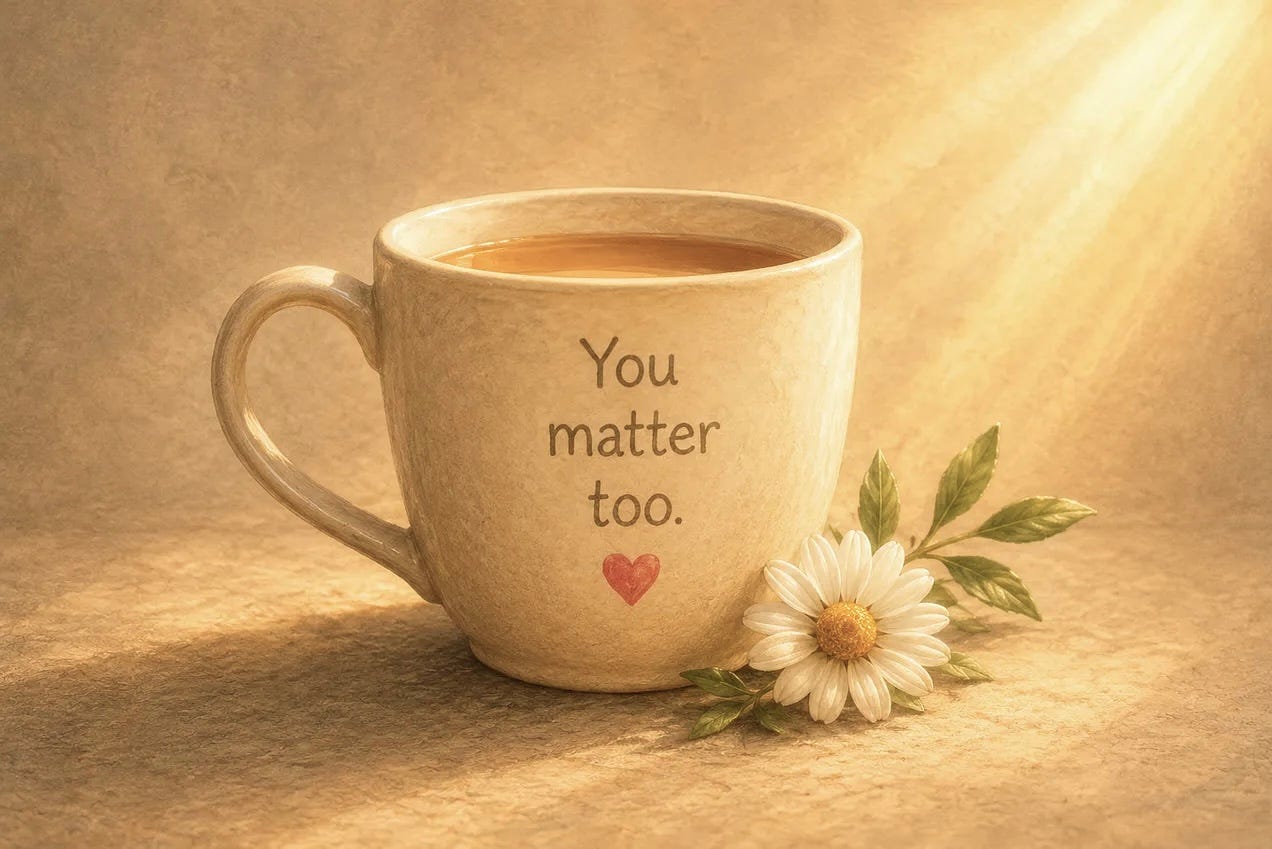
The conversation isn’t asking you to do less or become someone different. It is inviting you to notice the countless ordinary moments that already belong to you. The few minutes before the day gathers speed. The pause before answering another message. The chance to eat without hurrying. The opportunity to acknowledge something you’ve done well before moving on to the next task.
You don’t need a different life to experience those moments. You only need to stop assuming they must be earned.
Perhaps this week, instead of asking whether you’ve done enough to deserve care, you might ask a different question.
What would change if care became the way you lived today, rather than the reward you hoped tomorrow might bring?
Questions Worth Carrying Into Your Week
Where in your daily life do you keep telling yourself, “Later,” and what keeps that promise permanently in the future?
Which ordinary moment do you move through so quickly that you never notice it could become an act of caring for yourself?
If you no longer had to earn your own kindness, what would you do differently tomorrow morning?
One Small Experiment
For the next seven days, choose one ordinary moment that already exists in your routine.
Not a new habit… Not another task…
Perhaps making a drink, walking to your car, washing your hands, sitting down before work, or closing your laptop at the end of the day.
Each time that moment arrives, pause for one slow breath and ask yourself:
“How do I want to arrive at the next part of my day?”
Don’t force an answer.
Notice whatever comes.
Sometimes awareness changes more than effort ever could.
Until Next Time
I: Do you think I’ll remember all of this tomorrow?
Soul: Probably not all of it.
I: Then what should I remember?
Soul: That today was never asking you to become someone else.
It was only asking whether you were willing to show up for the person already living it.
Continue Your Journey with Wisdom Library
Become part of the community and start receiving exclusive content.
Explore the Perks, offering fresh perspectives on real-life problems, and providing practical, step-by-step guidance you can apply to everyday life.
If this article meant something to you, you can support Wisdom Library with a contribution, allowing the publication to grow and continue creating thoughtful content. Thank you for being here


One thing you didn't hit upon is that placing ourselves first is often interrupted as being selfish by others. Something that we are taught from a young age is a bad thing.
We need to rethink that attitude and temper how we perceive self care. Then perhaps we won't neglect ourselves so much.