

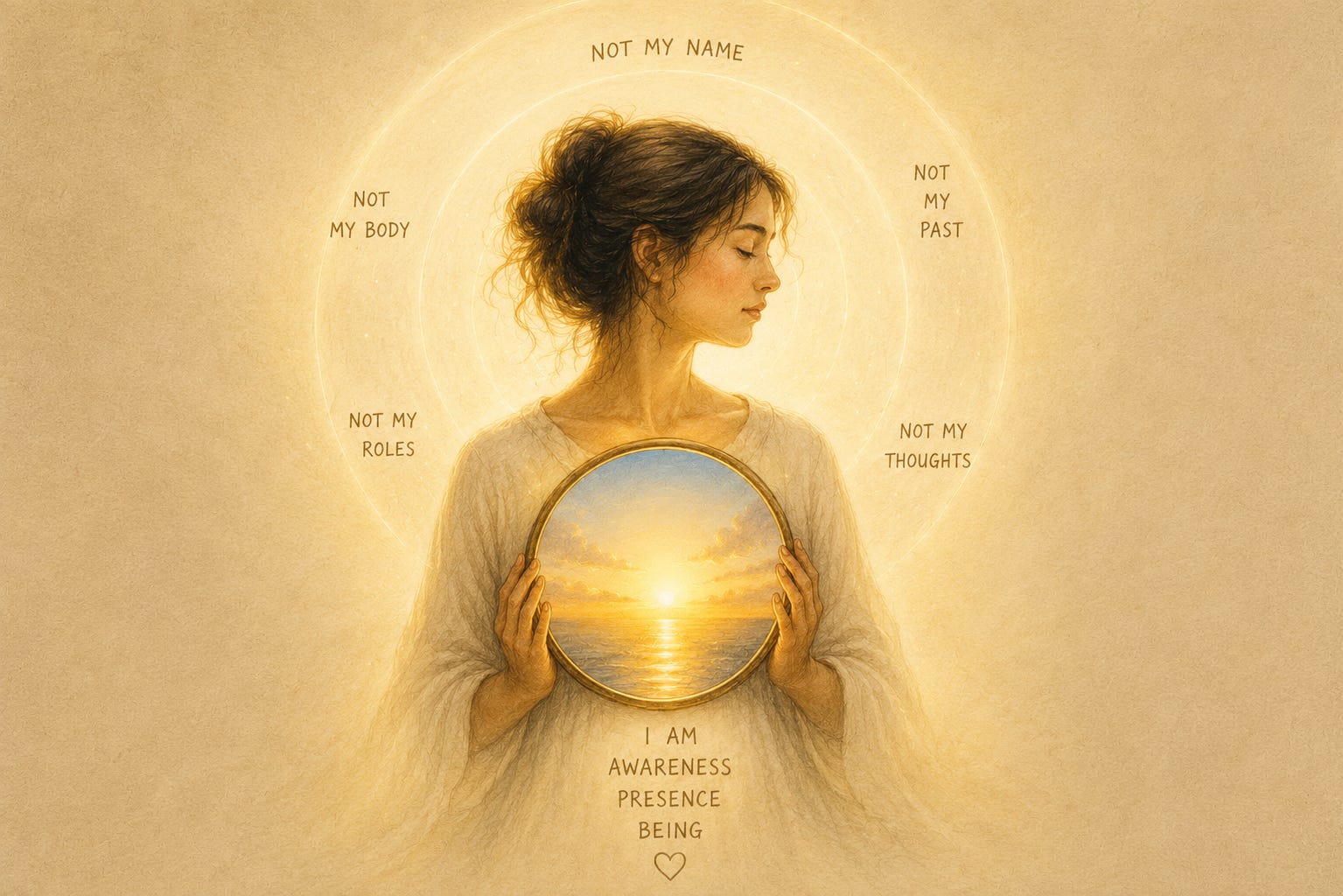
Most introductions begin the same way.
“What do you do?”
“Where are you from?”
“Are you married?”
“What keeps you busy?”
Within a few minutes, two strangers can know a surprising amount about each other. Or at least they think they do.
Years later, life has a habit of asking a different question.
It appears after redundancy. After illness. After children leave home. After retirement. After a relationship ends. After moving somewhere new where nobody knows your name.
Without warning, the labels begin to fall away.
And somewhere underneath them, another question appears.
Who am I now?
The Reflective Conversation
I: I’ve been thinking about identity.
Not the version we introduce at a dinner party. Something underneath that.
I realised that almost everything I use to describe myself could disappear.
Soul: What made you notice that?
I: I was filling in one of those forms that asks for your name, occupation, nationality and marital status.
I completed every box.
Then I looked at the page and thought...
None of this feels like me.
Useful information?
Yes.
But it doesn’t answer the question.
Soul: Perhaps because those boxes were never trying to.
I: Then why do I spend so much of my life believing they do?
Soul: Because they are accepted by everyone else.
They help people recognise you.
They help systems organise you.
They help conversations begin.
But recognition and understanding are not the same thing.
...
I: It starts with the name, doesn’t it?
Someone asks who I am.
I answer with the name my parents chose before I could even speak.
Soul: Your name belongs to you.
But have you ever believed that it was you?
I: Not consciously.
Soul: Yet imagine changing it tomorrow.
Would you feel slightly unfamiliar?
I: Probably.
Soul: Interesting.
Something given to you can become so familiar that it begins to feel inseparable from you.
That happens with more than names.
...
I: Then there is the body.
Most people would point to themselves and say, “This is me.”
Soul: Would they?
I: Isn’t that obvious?
Soul: Listen carefully to how people speak.
“My hand hurts.”
“My back is stiff.”
“My eyes are tired.”
We naturally say my body, my face, my hands.
We rarely say, “I am a hand.”
We instinctively speak as though the body belongs to us.
I: I’ve never paid attention to that.
Soul: Language often reveals assumptions we never stop to examine.
I: But I still experience life through this body.
If someone insults the way I look, it hurts.
If I become ill, it changes my whole day.
If I look tired in the mirror, my mood changes before breakfast.
Soul: Which is understandable.
The body is where your life is experienced.
Caring for it matters.
Confusing it with your entire identity is something different.
I: I suppose if I broke my leg tomorrow, I wouldn’t become less myself.
Soul: No.
I: If my hair turned grey.
Soul: You would still be you.
I: If I lost a hand.
Soul: You would lose a hand.
Not yourself.
I: Then why does ageing frighten so many people?
Soul: Because many people have quietly built their identity around how they appear.
Every wrinkle feels like losing part of themselves.
Every change in the mirror feels like evidence that they are becoming less valuable.
I: That sounds exhausting.
Soul: It is.
The mirror was never designed to answer the question, “Who am I?”
...
I: Then maybe I’m my thoughts.
Soul: Are you?
I: They certainly occupy enough of my day.
Soul: Have you ever watched your own thoughts?
I: Of course.
Soul: If you can notice them, who is doing the noticing?
I: I don’t know.
Soul: Thoughts arrive all day.
Some stay for seconds.
Others linger for years.
They contradict one another.
Yesterday you believed one thing.
Tomorrow you may believe another.
If your thoughts constantly change, would it be safe to build your identity on them?
I: Probably not.
Soul: Yet people defend opinions as though their whole existence depends on winning an argument.
I: I’ve done that.
Soul: Most of us have.
We confuse changing our mind with losing ourselves.
I: Why?
Soul: Because once an opinion becomes part of our identity, questioning the opinion feels like questioning our worth.
I: So sometimes I am protecting an identity, not a truth.
Soul: That happens more often than people realise.
...
I: Then maybe I’m my emotions.
Soul: Yesterday, were you exactly the same person when you felt frustrated at work and later laughed with someone you love?
I: No.
Soul: The emotions changed.
Something remained.
I: I can remember feeling anxious, excited, disappointed and hopeful, sometimes all within one day.
Soul: Which one was the real you?
I: I don’t know.
Soul: Perhaps none of them.
Or perhaps they were all experiences passing through someone larger than each emotion.
...
I: So if I’m not my name...
Not entirely my body...
Not every thought...
Not every emotion...
What is left?
Soul: Why are you assuming something must be left in the way you’re expecting?
I: Because otherwise the question has no answer.
Soul: Or perhaps it has an answer that refuses to fit inside a definition.
...
I: That feels frustrating.
Soul: Only because you are searching for a sentence instead of an experience.
I: Isn’t identity supposed to be something I can explain?
Soul: Think about the people you love most.
If someone asked you to describe them, you could list facts.
Their age.
Their profession.
Their hobbies.
Their achievements.
But would any of those explain why they are unmistakably themselves?
I: No.
They would all be true.
Yet they would still miss something.
Soul: Exactly.
...
I: Then why do I reduce myself to facts I wouldn’t use to describe someone I love?
Soul: Because facts are easier to measure than presence.
I: Presence?
Soul: Think of someone walking into a room.
Before they say a word, you often notice something.
Some people make others feel comfortable.
Others make everyone tense.
Some leave you lighter.
Others leave you exhausted.
None of that appears on a CV.
Yet it is often what people remember.
I: You’re saying who we are reaches people before what we say.
Soul: More often than we think.
...
I: I spend a lot of time improving myself.
Learning.
Working.
Exercising.
Becoming more organised.
Soul: None of those are problems.
I: Yet they never seem to answer the question.
Soul: Because improvement asks, “What can I become?”
Identity quietly asks, “Who is becoming all these things?”
...
I: Sometimes I wonder whether I’ve spent years collecting descriptions instead of understanding myself.
Soul: Most people do.
They collect roles.
Parent.
Partner.
Manager.
Friend.
Traveller.
Athlete.
Every role has value.
Problems begin when every role becomes your entire identity.
I: Because roles disappear.
Soul: Exactly.
...
I: How much of my life has been a reaction to protecting an identity?
Soul: Which identity comes to mind first?
I: The competent one.
I don’t like admitting that.
I want people to think I know what I’m doing.
I prepare more than necessary.
I check things twice.
Sometimes three times.
I worry about mistakes that nobody else would notice.
Soul: Is that because you enjoy doing good work?
I: Partly.
But if I’m honest...
There is something underneath it.
I don’t only want to do a good job.
I want people to see me as someone who always does.
Soul: There is an important difference between those two.
I: One is about the work.
The other is about protecting an image.
Soul: Yes.
I: The strange thing is that nobody ever told me to become that person.
Soul: Are you sure?
I: Maybe not directly.
Teachers praised me when I got things right.
People trusted me because I was reliable.
The more dependable I became, the more approval I received.
Somewhere along the way I stopped enjoying competence and started depending on it.
Soul: That is often how identities are formed.
They begin as useful adaptations.
Then they become expectations.
Eventually they become prisons.
I: I don’t remember making that decision.
I can’t point to a day when I thought, “From now on this is who I am.”
It happened so gradually that I mistook it for my personality.
Soul: Most identities don’t arrive with an announcement.
They are built one experience at a time.
Someone praises you for being responsible.
A teacher tells you you’re clever.
A manager thanks you for always being dependable.
Friends rely on you because you’re the one who never lets people down.
None of those moments seem important on their own.
But together they begin writing a story about who you believe you are.
I: And after a while I stop questioning the story.
Soul: Because it works.
It earns trust.
It earns approval.
It gives you a place in the world.
The problem isn’t that the story is false.
The problem is believing it is the whole story.
I: So eventually I begin protecting it.
Soul: Yes.
Not because someone asks you to.
Because losing it starts to feel like losing yourself.
I: That explains something I’ve never understood.
Sometimes I feel exhausted before the day has even finished.
Not because the work was particularly difficult.
Because I spent the whole day trying to live up to an image of myself.
Soul: There is a difference between doing your best and proving who you are.
People often confuse the two.
I: I think I have.
I always believed they were the same thing.
Soul: They can look identical from the outside.
Both people work hard.
Both care about doing things well.
But inside, one is driven by purpose.
The other is driven by fear of no longer being enough.
I: How do I know which one is driving me?
Soul: Ask yourself this.
If nobody knew you had done the work...
If nobody praised it...
If nobody thanked you...
Would you still want to do it?
I: I hope so.
But I’m not completely sure.
Soul: Then perhaps your motivation has become mixed.
There is nothing wrong with enjoying appreciation.
The danger comes when appreciation becomes evidence that you exist in the right way.
I: So perhaps the hardest identities to recognise are the ones that have served us well.
Soul: Exactly.
They rarely feel limiting.
They feel familiar.
Which is why people can spend years protecting them without realising they have become trapped inside them.
I: That word still feels uncomfortable.
Soul: Good.
Prisons rarely announce themselves as prisons.
They usually introduce themselves as responsibilities, strengths or even virtues.
Sometimes the qualities that help you succeed are the very qualities that stop you asking who you are without them.
...
I: Does everyone carry something like that?
Soul: Almost everyone.
Some need to be the successful one.
Others the funny one.
The strong one.
The helpful one.
The intelligent one.
The independent one.
At first they choose the role.
Eventually the role chooses them.
I: Then criticism becomes frightening.
Soul: Because criticism no longer feels like feedback.
It feels like an attack on identity.
...
I: Is that why one small comment can ruin my entire day?
Soul: Sometimes.
I: Even when I know the comment isn’t entirely true.
Soul: The words themselves are rarely the whole problem.
The meaning attached to them usually hurts more.
I: Meaning like...
“Maybe I’m not good enough.”
Soul: Exactly.
...
I: So I can care about my work without believing I am my work.
Soul: Yes.
I: Care for my body without believing I am only my body.
Soul: Yes.
I: Value relationships without believing they define my existence.
Soul: Yes.
I: It sounds easier than it feels.
Soul: Why?
I: Because success feels personal.
When something goes well, I feel valuable.
When it doesn’t, I begin questioning myself.
Soul: Then success has quietly become your mirror.
I: Isn’t that normal?
Soul: Common.
Not necessarily healthy.
I: How would I know the difference?
Soul: Imagine two people receiving exactly the same criticism.
One hears information.
The other hears a verdict about who they are.
The words were identical.
The identity listening was different.
I: Then reducing suffering isn’t always about changing circumstances.
Soul: Sometimes it begins by loosening your grip on the identity that keeps feeling threatened.
...
I: Is that why retirement can be so difficult for some people?
Soul: They don’t only lose a job.
They lose the answer they have given for forty years whenever someone asked who they were.
I: And when children leave home?
Soul: Some parents are not only grieving the change in routine.
They are grieving the role that quietly shaped every day of their lives.
I: So life keeps asking the same question in different ways.
Soul: Yes.
“Who are you now?”
...
I: Then what are we, in your view?
Soul: Some questions are not problems to solve.
They are directions to keep facing.
I: I still want certainty.
Soul: Why?
I: Because certainty feels safe.
Soul: Until life changes.
Then the definition begins arguing with reality.
I: Maybe that’s why people struggle after losing a career, a relationship or their health.
Soul: They are not only grieving what happened.
They are grieving the version of themselves that no longer fits.
...
I: I still feel there must be something constant beneath everything.
Soul: Notice what has remained through every stage of your life.
The child.
The teenager.
The adult.
Your appearance changed.
Your beliefs changed.
Your friendships changed.
Your ambitions changed.
Yet there is still a familiar sense that all those versions were lived by the same someone.
I: I know exactly what you mean.
I just don’t know how to explain it.
Soul: Maybe not everything meaningful needs to become a definition.
I: So perhaps the question isn’t, “Who am I?”
Soul: What question would you ask instead?
I: What part of me remains when everything I own, every role I play and every label I carry changes?
Soul: Keep asking that.
Don’t rush to answer it.
Some questions are meant to accompany your life rather than conclude it.
Who Are You Without the Story You Tell About Yourself
Most of us move through life introducing ourselves with information that helps other people recognise us. There is nothing wrong with that. We all have names, responsibilities, relationships and stories that matter.
The challenge begins when those things become the whole answer.
Life changes more often than we expect. Jobs end. Bodies age. Relationships evolve. Opinions mature. If your entire identity rests on things that can change, every change can feel like losing part of yourself.
Perhaps this week, instead of asking what you want to achieve next, spend a little time asking what has remained constant through every moment of your life. Not to arrive at a perfect answer, but to become more curious about the part of you that continues to experience life while everything around it changes.
You may discover that understanding yourself is less about collecting new labels and more about becoming less dependent on them.
Questions That Might Change the Way You See Yourself
Which label or role would be hardest for you to lose, and what does that reveal about how you see yourself?
When have you felt most like yourself, even though nothing about your circumstances was particularly impressive?
If someone removed every title, achievement and expectation from your life for one day, what would still remain unmistakably yours?
A Small Experiment for the Week Ahead
At the end of each day this week, write down three sentences.
Today I played the role of...
Today I believed I was...
Beyond both of those, what part of me quietly witnessed the whole day?
Don’t try to answer perfectly. Notice whether the answer changes the way you experience tomorrow.
A Conversation Worth Returning To
I: Do you think one day I’ll finally know exactly who I am?
Soul: I think you’ll spend less time trying to become someone else that society wants you to be.
I: Is that enough?
Soul: It might be where the real answer begins…
If this article meant something to you, buying me a coffee is a simple way to support my work. Every contribution helps Wisdom Library continue to grow. Thank you for being here. 💛
Thanks for this reflection. It’s enlightening and thoughts provoking.
What a lovely conversation I can’t wait to get started with similar for souls who have an ambition for something outside of this world