


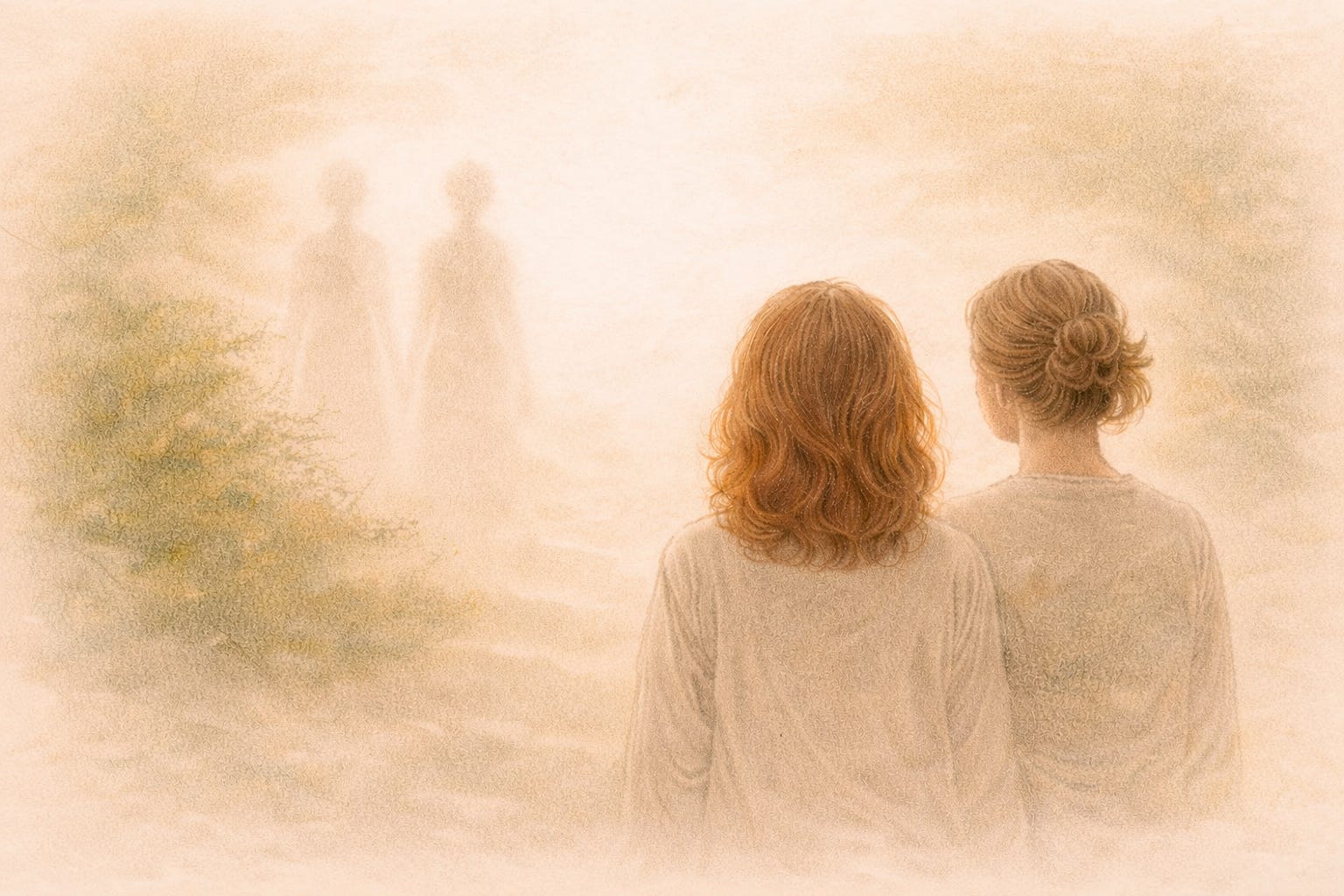
This piece feels a little different because it’s not just one voice. It’s written side by side by Alexandra Pasareanu and Andrea Thorfinson
Alexandra Pasareanu shares the wisdom she gathered through her own lived experience. What she writes about isn’t just theory. It’s what she wrestled with, questioned, softened into, and slowly understood through her own journey. Every article she publish is an invitation - not to agree with her, but to reflect. To pause. To become a little more self-aware in the middle of your real, ordinary life.
Andrea Thorfinson brings her own grounded depth to this space. If you’re spiritually curious, you’re in the right place with her. She writes about meditation, healing, and spirituality in a warm, come-as-you-are way. No pressure to be enlightened. No spiritual performance required. Just honest exploration - including for those who experience things differently, like living with aphantasia.
Together, this perspective about death, the soul, and what continues after the body stops isn’t about convincing you of anything. It’s about exploring it from 2 lived perspectives. Side by side. Open-hearted.
It’s Not the End - It’s a Beginning We Forgot About
Here is the thing about death - most of us are not actually afraid of being dead. We are afraid of disappearing. Of losing the people we love. Of being lost in some endless silence.
For most of my life, I carried that quiet fear in the background. It would sneak in at night. And then curiosity surfaced: What happens when we die? Is it just blackness? Is it nothing? Then why we have this life, what for?
Let me say that I write this article not as someone who guesses or someone who just assumes one thig over the other. I became a member of IONS (Institute Of Noetic Science) who explores consciousness, I read about death and the after death, I spoke with several people, I keep an open mind, I attended neuroscience & consciousness events, read articles on the topics, and so much more. I did a bit of research over the years out of curiosity and out of a deep down believe that the life we have here cannot be it… there is more to it.
And as a result of all this I started to believe that we might not actually die. The body stops working but the soul does not.
If that’s true, then death is not an ending. It is a continuation - growth without the weight of the physical body. New adventures. Expanded awareness. Endless possibility. The body is temporary, like clothing we wear for a while. Consciousness continues. Love experienced on earth continues. The people we think we’ve lost move into another dimension, not into oblivion.
Honestly, that idea changes everything to me.
Missing Them - But Not Losing Them
When someone you love dies, the ache is physical. Your chest feels tight. The silence in the room feels louder than anything. You miss their voice. Their laugh. The way they used to say your name.
The hardest part is the idea that they are gone forever.
But what if they’re not?
There is still grief in this perspective - let’s be clear about that. Believing the soul continues does not cancel the pain of not being able to hug them. The longing doesn’t just evaporate. What shifts is the finality.
Instead of “they’re gone,” it becomes “they’re somewhere else.”
And that subtle difference changes the texture of grief. It turns despair into hope. It turns permanent separation into temporary distance and once day you will meet them again.
Sometimes I think the real pain is not death - it is the belief that connection has ended. When you begin to see death as a doorway rather than a wall, the grief breathes differently. You still cry. But underneath it, there is a quiet knowing.
Missing them does not mean you’ve lost them.
It’s Not the End - It Was the Beginning of My Unravelling
I was eight years old when I first met death.
My Nana, the woman who raised me, died, and I remember standing in the quiet aftermath wondering where she had gone. The religion I was raised in offered answers, but none of them settled in my body. Eventually, I stopped asking. I decided there wasn’t an answer. Somewhere along the way, I slipped into a deep sadness and declared myself an atheist. It felt easier to believe there was nothing than to wrestle with uncertainty.
So, when my husband Ed died at twenty-six, I had no spiritual framework to fall back on.
I experienced the loss in the most physical way possible. The silence where his breathing had been. The empty side of the bed. The way his scent slowly faded from our home. Grief was not philosophical. It was embodied. I missed his arms, his voice, the way he said my name. I missed the simple fact of his existence in our shared space.
If death was final, if consciousness ended with the body, then everything we had built together had simply vanished.
That thought was unbearable.
So I began asking again. Not because I suddenly became spiritual, but because love refused to accept erasure. I revisited the religion I had left. I explored others. I read. I listened. None of it handed me proof, but something began to stir. It wasn’t quite belief. It felt more like recognition, like something long dormant was being gently reawakened.
The Body Was Never the Whole Story
If the soul continues, then our relationships continue too.
That idea used to sound sentimental to me. Now it feels logical. If we are souls having a human experience, then this lifetime is one chapter - not the entire book.
I’ve come to see the body as a vehicle. Necessary, beautiful, fragile. But not the core of who we are. The soul is the real us - the awareness behind the eyes, the energy that animates the body. When the body stops working, the soul steps out of it the way we step out of clothes at the end of the day.
The transition, as it’s described spiritually, is almost like waking up. Imagine falling asleep in one room and waking up in another - different setting, same you.
There is often a period of what I think of as detoxing - a shedding of the heavy emotions, illness, and pain carried in the physical world. The soul releases the density of human experience. Then comes what mediums call a life review - not a judgment, not a punishment. A review through the lens of pure awareness. You see your life clearly. The love you gave. The love you withheld. The impact you had. The lessons you learned.
It is not about shame. It is about understanding.
And here’s something that moves me deeply - we are not alone when we cross over. There are accounts from near death experiences where people describe being greeted. Loved ones. Pets. Guides. Angels. As if someone is there saying, you made it. You can rest now.
From their side, there is no space or time the way we experience it. They can see us. Hear us. Visit us. They retain their personality - their humor, their preferences, their quirks. The difference is they no longer carry jealousy, resentment, or fear. The heavy emotional layers dissolve. Love remains.
And love, from that place, is pure. Unconditional. Infinite.
We can talk to them. Out loud. In our thoughts. Because consciousness does not require a body to connect.
There’s also the idea that after passing, souls take on some work. Heaven is not passive. It’s purposeful. Some choose to guide others who struggle in areas they once struggled in. Some support family members. Some prepare for future incarnations.
Reincarnation - honestly - makes more sense to me now than it ever did. The soul exploring different lives to learn different lessons. Each lifetime adding knowledge to a vast, shared field of consciousness.
And there is a part that can be uncomfortable. The idea that we chose certain lessons before arriving. That even the hard things may serve growth at a soul level.
I know that can feel confronting, especially when life has been painful. But perhaps the choosing happened from a perspective far wider than the one we have in a body.
Some souls seem to have lighter paths - maybe they are here for subtler lessons. Creativity. Leadership. Joy. Others walk through fire repeatedly - maybe they are here to master resilience, forgiveness, boundaries, healing generational patterns.
From a spiritual lens, there are no victims. Only souls having different curriculums.
That perspective doesn’t dismiss pain. But it reframes it.
Around that time, subtle experiences began to interrupt my certainty that death meant disappearance. Dreams that felt different from ordinary dreams — clearer, more coherent, lingering long after I woke. Moments when I would suddenly smell his cologne in an otherwise empty room. Our three-year-old wrapping his arms around me and whispering, “Daddy still loves us,” without any prompting from me.
These moments weren’t constant, and they weren’t dramatic. But they were enough to make me pause.
Then a coworker handed me a small book for my boys: Water Bugs and Dragonflies. It tells the story of water bugs living beneath the surface of a quiet pond. Every so often, one climbs the stem of a lily pad and disappears. The others are confused and afraid, so they make a pact. The next one who makes the journey will come back and tell them what is beyond the surface.
Eventually, one does.
He emerges transformed into a dragonfly, discovering a world of light and air. He tries to return beneath the water to keep his promise, but he cannot. Not because he doesn’t want to, but because he has changed.
When I read that story, something inside me softened. I had been waiting for Ed to come back and explain everything, to tell me where he went, to reassure me in the way I understood reassurance. Then I began to ask myself, what if he couldn’t return in the way I expected, not because he was gone, but because he no longer fit this form?
That question opened a door.
The Soul Is the Real Us
If I truly accept that I am a soul first and a body second, my fear of death softens.
Earth starts to look like a classroom. Intense at times. Beautiful. Messy. But temporary. The spirit world becomes less of a distant fantasy and more of a home base.
It also explains why people continue to feel signs. The random song at the perfect moment. The dream that feels too vivid to be coincidence. The sudden memory that carries comfort.
When someone dies, from our side it feels like ultimate distance. From theirs, it feels like closeness. They see the full landscape. They understand more. And the last thing they want is for us to be trapped in guilt or sorrow. They want us to live. Fully. Boldly. Without restriction.
Because this life - as heavy as it can feel - is precious.
Over time, what began as questioning deepened into remembering. Through spontaneous past-life recall and later regression, I experienced something that felt less like imagination and more like peeking beyond a veil. I came to know, with a certainty I cannot logically prove but also cannot deny, that Ed and I have shared many lifetimes together. It felt both emotional and conceptual, like finding a missing piece of a puzzle I hadn’t realized was incomplete.
If this wasn’t our first life together, then it wouldn’t be our last.
That understanding reshaped death for me. Life no longer felt random in the way I had once assumed. I began to see it as intentional. I believe now that before we come here, we choose certain experiences, certain relationships, certain lessons. Not from a place of punishment or judgment, but from a desire to grow and expand.
I believe there is something like a life review when we return home, not as condemnation, but as understanding. A clear seeing of where we acted from love and where we let fear or ego lead. A recognition of what we completed and what still calls for balance.
And yes, I believe Ed and I had a soul contract.
I believe part of that contract included his early death, not as tragedy for tragedy’s sake, but as an awakening point for me. In another lifetime, I did not survive the weight of grief. I ended my own life. In this one, when he died, I came dangerously close to repeating that pattern. There was a version of me after his death that nearly collapsed, that could not see how to continue. The pull to escape the pain was real. Staying was not automatic. It was a decision made again and again.
But I stayed.
I learned to hold grief without letting it consume me. I learned to remain inside pain without disappearing. Breaking that cycle feels significant at a soul level. When I look at his death through that lens, it no longer feels like punishment. It feels like part of an agreement, one that asked me to awaken, to remember, to stay.
That does not make it easy. It makes it meaningful.
As for Ed, I don’t believe the personality I knew here was the entirety of his soul. That was one expression of something much larger. But I do believe he retains awareness. I don’t experience him as dissolved into abstraction. I experience him as continuing.
Living Like the Soul Is Eternal
If death is a transition and not a termination, then the way we live can change.
We can speak to our loved ones who have passed. Try to hold grudges less tightly. If we are eternal beings, why waste time in resentment?
We can prioritize meaning over material accumulation. The body doesn’t take anything with it. The soul takes the lessons. The love. The growth.
And I am less afraid of goodbye. Not completely fearless - I am still human. But softer. More trusting.
Because if love truly never dies, then separation is temporary.
Now, when something difficult happens in my life, I still sometimes begin with the human question of why. But I rarely stay there. The question shifts into something else: What is this shaping in me? What is this teaching me about love, about resilience, about presence? Sometimes the answer is immediate. Sometimes it takes years. Sometimes it may remain a mystery. But I trust that my life is not random suffering in the way I once believed it was.
I no longer experience death as annihilation. I experience it as transition. The form changes. The relationship does not end.
There is still warmth. There is still partnership. There is still a sense that love continues to move between us, even if the medium has changed.
I once believed death erased everything.
Now I understand it as an invitation to expand how I define love, how I understand identity, and how I see the continuity of the soul.
The Questions We Are Living With
If the soul is eternal, if death is just a transition, then why does it still scare us?
I don’t think it’s the soul that’s afraid. I think it’s the body. The body is wired to survive. The ego is wired to control. Death feels like losing both control and identity. From the body’s perspective, it looks like the end.
But when I sit quietly, there’s a deeper part of me that doesn’t feel panic. It feels steady. Almost familiar. Like it knows this isn’t the full story.
Maybe we’re not afraid of death itself. Maybe we’re afraid of separation. Of not being able to see, touch, or hear the people we love. And if love actually continues, then that fear is coming from a limited view.
That doesn’t make me fearless. It just helps me understand where the fear comes from. And that changes how I hold it.
And what is my soul here to learn this time?
When something difficult happens, I still get frustrated and hurt. But instead of staying in why is this happening to me, I try to ask what is this changing in me?
Is this teaching me boundaries? Resilience? Compassion? Self-trust?
If I am a soul having a human experience, then this life isn’t random. It’s intentional. Even the hard parts serve something. Not as punishment, but as growth.
That perspective doesn’t solve the struggle. But it gives it purpose.
It reminds me that what I build inside - strength, love, wisdom - is what actually lasts.
And maybe that’s the real work of being here.
For a long time, the question wasn’t what my soul came here to learn. It was simply how to survive what had already happened.
After Ed died, growth felt like an insult. Meaning felt impossible. I wasn’t looking for lessons. I was trying to breathe through another day.
Only later did the question begin to change.
Not “why did this happen”, but “what did staying make possible”?
I learned that grief and love can exist in the same space. That pain doesn’t always disappear. Sometimes it transforms. That continuing to live, to love, to remain open after loss may itself be part of the work.
I still don’t claim to understand the full purpose of suffering. But I trust now that nothing we love is ever wasted and that what we become through loving and losing may be what the soul carries forward.
Your Turn To Reflect
What if you are not afraid of death - just the idea of separation?
Who would you speak to tonight if you believed they could hear you?
How would you live if you truly understood this life is not the end, but one chapter in a much longer story?
Understanding where we go when we die should change how we live now. If the people we love are not gone but simply in another dimension of awareness, then the connection is not broken - it is transformed.
Maybe that sudden memory that warms you was not random. Maybe that feeling of being watched over is not imagination.
Maybe death is not an ending at all. Maybe it is a return home from a journey on earth.
Live fully. Love without holding back. Trust that this physical life is just one extraordinary part of your soul’s endless journey.
Thank you for reading and reflecting alongside us Alexandra Pasareanu and Andrea Thorfinson
If you found this article meaningful or useful, I’d truly appreciate it if you could share it. It helps to spread more wisdom in the world.
Thank you both for being so open and writing such a clear, powerful and soulful post.
It really moved me in a way I can't explain. It resonates so much as Andrea knows I've had past life readings and have done research and still do on life between lives, NDEs and I have had what I believe was a visitation from a family member who passed on, she also visited 2 other family members within the same week.
Death is most definitely not the end, you're both right - it transforms how we see it yet grief as you pointed out still remains because of that separation and the memories you built.
I hope this reaches an abundance of people especially those with an open mind, curious mind or those who are suffering with grief as it is truly one of the hardest things to go through in this human experience.
Thank you both again 💜
Kudos to both of you for bringing such an open-hearted exploration of death, consciousness, and what may continue beyond the body into this space. These are conversations our culture often avoids, yet they are among the most meaningful ones we can have.
As a death doula, I’ve spent time at many bedsides, and one thing I’ve come to appreciate is how deeply the body is wired to survive. There are moments when it can almost feel as if the body is holding on while something deeper — what many of us might call the soul — is already beginning to loosen its grip.
Your reflections on the possibility that consciousness continues resonate with what I have come to sense through this work. I often think of dying not as disappearing, but as stepping into another room — one we cannot yet see, but that love still connects us to. The essence of the person — the love, the presence, the imprint they leave — does not feel gone.
And yes, the idea of soul journeys or soul agreements can help us hold some of life’s hardest questions with a little more compassion — especially when someone leaves this world far too young.
These are themes I find myself returning to often in my own writing about the thresholds between living and dying.
Thank you, Alexandra and Andrea, for opening such a thoughtful and spacious conversation. Pieces like this invite us to sit with mystery rather than rush to close it.