

Stress has a funny way of showing up uninvited. Sometimes it barges in with loud footsteps, like when your inbox fills faster than you can clear it. Other times it slips in quietly, maybe while you’re standing in a grocery store line that refuses to move, or right when you finally crawl into bed and hope your mind will give you a break. If you’re anything like me, you probably know that feeling of wanting your body to settle down but not quite knowing how to coax it there.
Over the years, I’ve learned something simple but strangely easy to forget: calm doesn’t have to wait until life gets easier. We don’t need to earn it by finishing every task or solving every problem. Sometimes, calm just needs a small opening. And more often than not, that opening begins with the breath.
Breathwork sounds like a big, official thing, but it isn’t. It’s not about achieving perfect technique or turning yourself into a Zen master. It’s about using what you already carry with you, every minute of every day, to ease your way back into yourself. Intentional breathing has helped me step out of spirals, fall asleep on restless nights, and return to center in moments I would’ve otherwise lost to stress.
Today I want to share three practices that have become part of my daily rhythm: box breathing, 4-7-8 breathing, and resonance breathing. They all work a little differently, but each one has taught me something about how the body responds to gentleness and patience. You can do them anywhere—your kitchen, your commute, the corner of a busy room where no one even notices you’ve paused.
Think of these practices less like “techniques” and more like tools you can keep in your pocket. Tools for meeting stress with steadiness instead of resistance. Tools for carrying yourself through the world with a bit more softness.
Practice 1: Box Breathing For Instant Calm
Let’s start with the technique I reach for most often, the one that feels like pressing a quick reset button on my nervous system.
What It Is
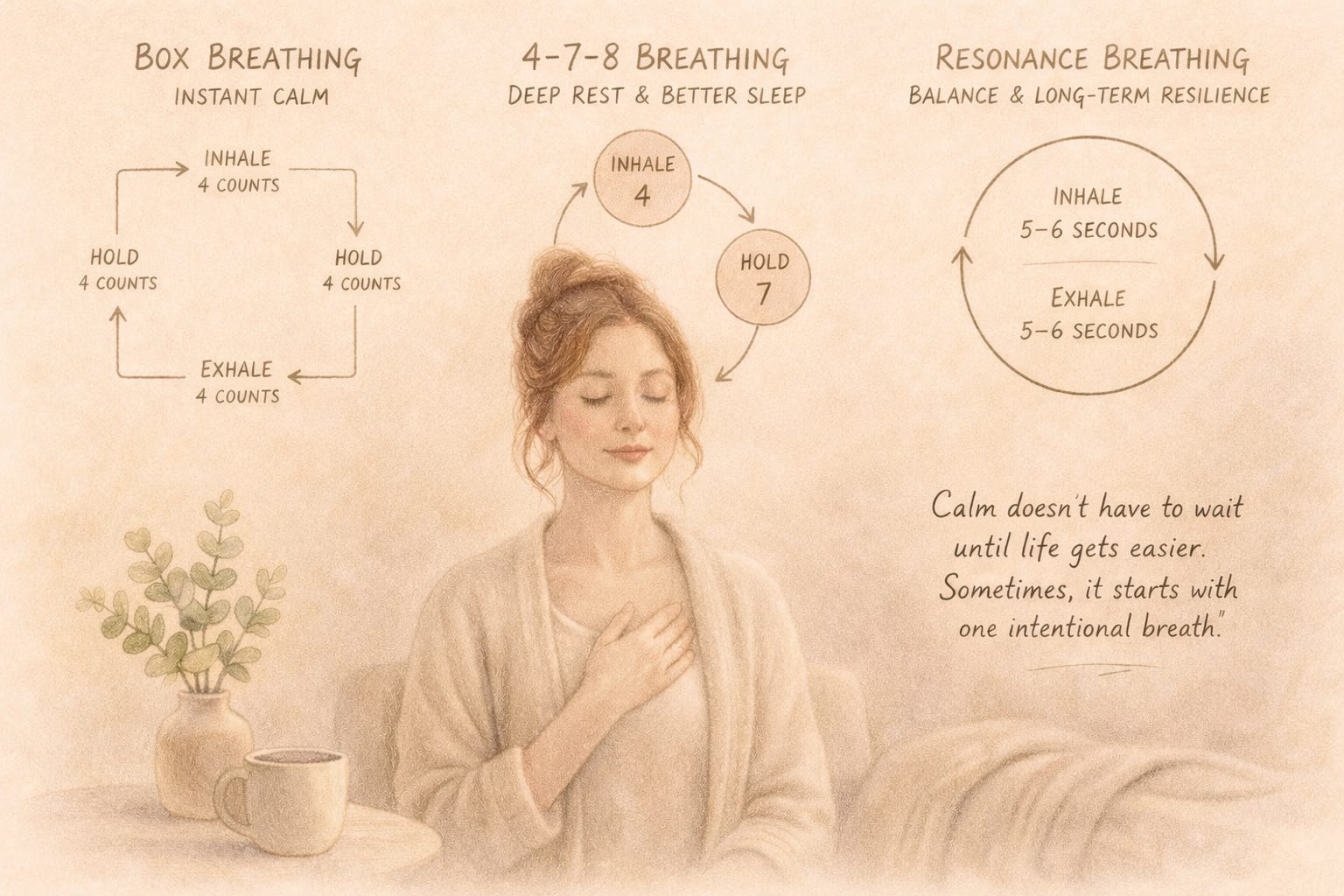
Box breathing is simple: inhale, hold, exhale, hold. Each for the same number of counts. Four equal steps, like the four sides of a box.
If you’ve ever searched “how to do box breathing,” you already know there’s nothing complicated hiding behind the name. And maybe that’s the magic of it. When everything around you feels unpredictable, box breathing offers structure. A gentle rhythm to lean on. It steadies your internal pace in a way that feels almost surprisingly comforting.
Where It Comes From
Most people hear about box breathing through military training or performance psychology, but versions of this pattern have existed for a long time. Yogic pranayama uses breath retention to cultivate focus, clarity, and balance. But box breathing strips the practice down to something clean and accessible—no spiritual framing needed unless you want it. Just breath, counting, and a sense of supported stillness.
What It Helps With
Box breathing is my go to when things feel like they’re slipping out of my hands. It can:
Lower stress quickly
Nudge the nervous system out of fight or flight
Pull scattered attention into one grounded moment
Create a tiny pocket of space between stimulus and reaction
Those pauses—the ones after the inhale and after the exhale—are often the most soothing part. They’re like small invitations to rest.
When I Use This
Honestly, I use box breathing everywhere. Before a tough conversation. Moments before speaking in front of a group. Sitting at my desk while emails multiply on the screen. Even in the middle of heated discussions when my chest starts to tighten.
At night, if I wake up with my mind racing, I’ll settle into the four count rhythm until my thoughts soften and my body gets the message that it’s safe to drift back to sleep.
Why It Helps Me
There’s something grounding about the consistency of it. When my thoughts feel messy or loud, the counting gives them a place to land. And those little pauses remind me—quietly—that rest is a valid part of life’s rhythm. Not everything needs to be inhale and exhale, push and release. Sometimes the stillness is just as important.
How To Do It
A basic four count version works beautifully:
Inhale through your nose for 4 counts
Hold for 4 counts
Exhale for 4 counts
Hold for 4 counts
Repeat a few rounds. No forcing. No straining. Just a steady rhythm.
Tips And Variations
Try 5 or 6 counts once it feels comfortable
Add a silent word like “steady” or “here”
Keep the breath subtle if you’re in public
A Few Precautions
If you’re pregnant, have lung or cardiovascular conditions, or feel lightheaded easily, shorten the pauses or skip them entirely. Breathwork should never feel like you’re wrestling with your own lungs.
Practice 2: The 4-7-8 Pattern For Deep Rest And Better Sleep
What It Is
The 4-7-8 technique uses a long, slow exhale to guide the body toward rest. There’s something almost luxurious about stretching the breath out like that—like wringing tension from your muscles one count at a time.
This pattern is especially good for evening wind down. When your mind refuses to close its loops, the long exhale begins to do the closing for you.
Where It Comes From
The roots go back to pranayama, like many breath practices, but this particular ratio became popular through Dr. Andrew Weil. He introduced it as a simple way for anyone to calm their system without needing prior experience in yoga or meditation.
What It Helps With
For me, 4-7-8 breathing is all about transition. It helps shift my body from the doing part of the day into the resting part. It can:
Slow a racing mind
Reduce physical tension
Lower heart rate
Create an internal signal that the day is done
When I Use This
Most nights, honestly. Especially if the day has felt like one long, buzzing current of activity.
Sometimes I use it in the late afternoon, right after I wrap up work, when I need to separate my brain from the momentum of deadlines. It’s like clearing a small runway before landing into the evening.
Why It Helps Me
The exhale is my favorite part. It feels cleansing in a way that’s hard to explain, like releasing air that’s been sitting deep in the chest for too long. By the end of the eight count, I usually feel my shoulders soften.
The counting also interrupts mental spirals before they can fully form. It gives my mind just enough structure to stop ruminating.
How To Do It
The basic pattern:
Inhale for 4
Hold for 7
Exhale for 8
Repeat up to 4 cycles to start, then gradually work up to 8 cycles if it feels helpful.
Tips And Variations
If the counts feel long, shorten them to something like 3-5-6
Try it lying down before bed
Keep the exhale soft, not forced
Precautions
Pregnant women should avoid the long breath holds. Anyone with lung issues should shorten the counts. And if you feel dizzy, stop and return to normal breathing before trying again.
Practice 3: Resonance Breathing For Balance And Long Term Resilience
If box breathing is a quick fix and 4-7-8 is a bedtime ritual, resonance breathing is more like daily maintenance. It’s the practice that has reshaped my baseline, not just my moments of stress.
What It Is
Resonance breathing slows you to about 5 or 6 breaths per minute. This is considered the body’s natural “resonance frequency”—a pace where the heart, breath, and nervous system start to synchronize.
Unlike the other two techniques, resonance breathing isn’t about immediate relief (though it does feel soothing). It’s about long term regulation. Consistency matters more than intensity.
Where It Comes From
This practice comes mainly from modern research on HRV (heart rate variability) and psychophysiology. But if you’ve ever watched someone meditate, chant, or move slowly through qigong, you’ve probably seen versions of this pace. Humans have gravitated toward slow breathing for centuries, long before science explained why it works.
What It Helps With
Resonance breathing is especially good for:
Managing chronic stress
Building emotional resilience
Regulating mood
Supporting cardiovascular health
Improving focus and clarity
When I Use This
I usually save it for mornings or slow afternoons. Ten minutes is enough to clear mental clutter and help me feel less pulled in ten directions.
It’s also the practice I return to when I feel overwhelmed by multitasking. Something about slowing the breath slows the mind too, like shifting from fast forward back into real time.
Why It Helps Me
Resonance breathing reminds me that my internal pace doesn’t have to match the external pace of my life. Even on busy days, I can choose a calmer rhythm.
After a few minutes, I feel a subtle softening throughout my body. My jaw unclenches. My posture eases. My thoughts stop rushing. It’s not dramatic, but it’s steady, and that steadiness accumulates.
How To Do It
A simple version:
Inhale for 5 or 6 seconds
Exhale for 5 or 6 seconds
Continue for 5 to 10 minutes
The breath should feel smooth, like a wave rolling in and another rolling out.
Tips And Variations
Even 3 minutes helps
Try pairing it with a slow walk or gentle stretching
Practicing at the same time each day builds the habit
Precautions
If slow breathing makes you anxious or short of breath, shorten the counts. Go gently.
Why Daily Practice Matters More Than Occasional Use
Something I learned the hard way: these techniques work best when I practice them on calm days too, not just when things are falling apart. Breathwork isn’t only for emergencies. It shapes how your nervous system responds long before the stress even arrives.
Think of it the same way you think of hydration. You don’t wait until you’re severely dehydrated to drink water. You sip throughout the day so your body stays balanced.
The same goes for breathing. A few minutes each day strengthens the pathways your body uses to shift into calm. So when life throws something unexpected your way, you don’t have to start from scratch. Your system already knows how to return to steady ground.
Breathwork won’t erase your deadlines or magically make traffic disappear. But it does carve out space inside the chaos. It gives you a moment to step back and choose your response instead of being swept into reactivity. And honestly, that tiny bit of space is often where sanity begins.
A Small Story: The Day Box Breathing Saved My Morning
Not long ago, I found myself stuck in bumper to bumper traffic on the way to an appointment I really couldn’t be late for. Maybe you’ve had mornings like that—your body tensing one muscle at a time as if clenching could somehow move the cars forward.
My chest was tight. My jaw locked. Every minute felt like a personal attack. And beneath all of it was that old familiar feeling of helplessness.
I caught myself gripping the steering wheel a little too hard, the way I used to before breathwork became part of my life. Instead of spiralling, I started box breathing. Four in, hold, four out, hold.
The first round felt clumsy. I was still annoyed. But somewhere around the second or third round, things shifted. My heart rate slowed. My shoulders dropped. The noise in my mind softened into something quieter.
The traffic didn’t change—not a bit. But I did.
By the time I arrived, I wasn’t frazzled or shaky. I felt steady. Present. Able to walk into the appointment as the version of myself I wanted to show up as, not the version shaped by a stressful commute.
That’s what these small practices do. They don’t erase the chaos of the world, but they protect you from getting swallowed by it.
Your Turn: A Few Gentle Questions To Explore
If you feel called to make breathwork part of your daily life, here are a few prompts that might help you ease into it:
Where in your day could you slip in a pause?
Right before opening your inbox? During your commute? As you switch between tasks? Notice the moments when your body tightens or your patience thins. Those are doorways into practice.
How do short practices feel compared to longer ones?
Try box breathing one day and resonance breathing the next. Notice the difference in your mind, your pace, your mood.
What would your evenings feel like if you added 4-7-8 breathing before bed?
Experiment for a week. Track how you fall asleep, how you wake up, how rested you feel.
Breathwork is personal. You’ll find your rhythm. And maybe, over time, you’ll start to notice something small but meaningful: that calm isn’t as far away as it used to feel.
Sometimes it’s just one breath closer than you think.
If this article meant something to you, buying me a coffee is a simple way to support my work. Every contribution helps Wisdom Library continue to grow. Thank you for being here. 💛
Thank you for explaining the foundation of breathwork in a relatable and applicable way. Having a daily breathwork practice is an important part of self-awareness and connecting with our inhererent essence 💜
You would of read this in my book about this.sort of thing (my life I in a Nutshell) but my favourite is in 6 hold 6 and out 6. Works well for me.