

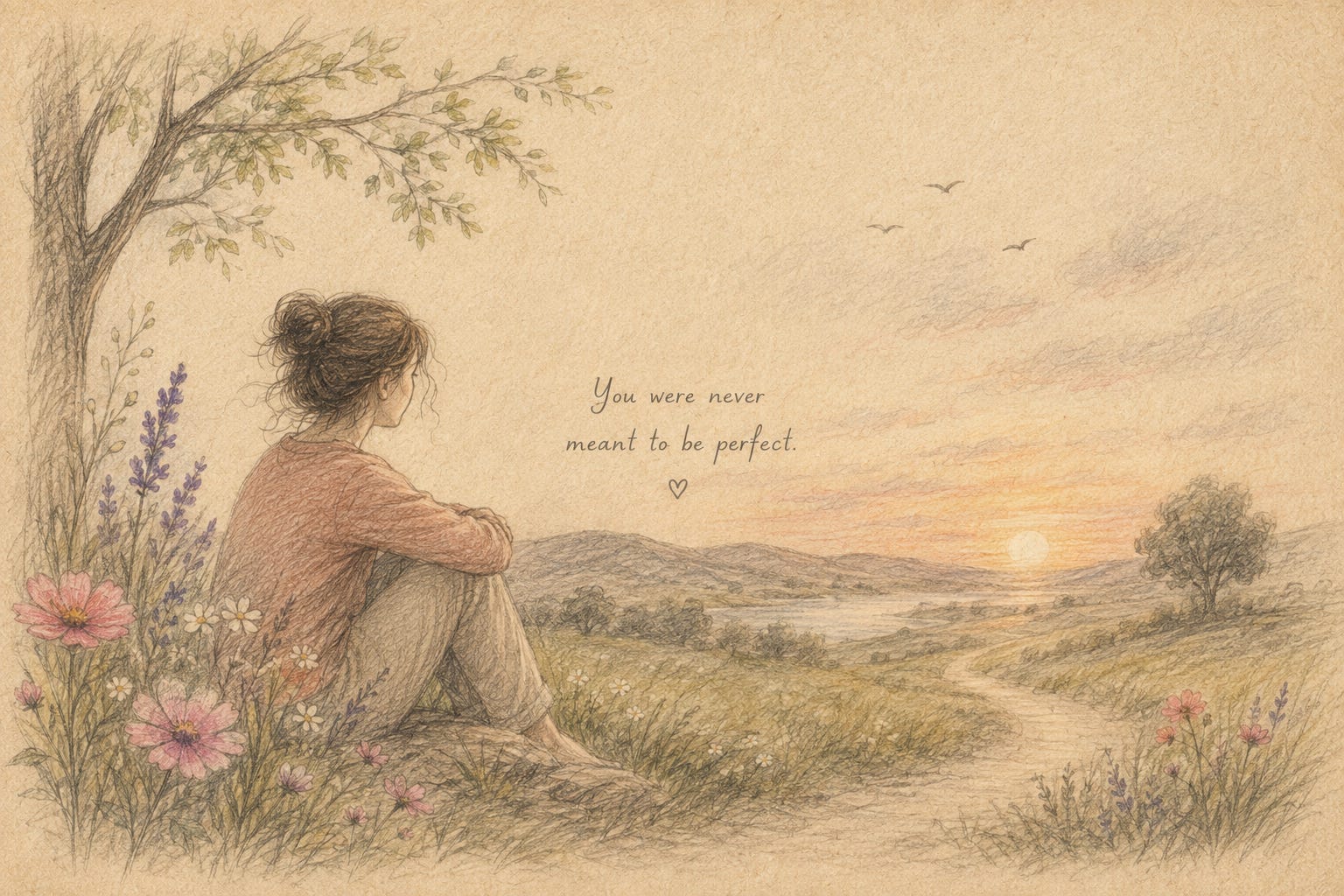
Imagine that, for a moment, you could step outside everything you know about your life today.
Not to decide whether your life has been planned… not to prove that souls return… but only to wonder...
What if you could look at one lifetime as a chapter in a much longer journey?
Perhaps there are experiences you would never choose if comfort were the only thing that mattered. Experiences that, from the inside, could feel confusing, unfair or exhausting... yet might reveal something that could never have been understood from a distance.
Imagine being given the chance to live a life where one particular experience follows you for years.
You hear criticism when you are young.
You become familiar with the feeling of getting something wrong before you have even finished trying. You learn to notice the expression on someone’s face before they speak. You become aware of the small changes in a voice, the pause before a comment, the sentence that begins with, “You should have...”
At first, you do not know that this experience will become part of the person you are becoming.
You are only living it. You are learning how it feels to be constantly evaluated. You are discovering what happens inside you when approval always seems slightly out of reach.
And eventually, you begin to carry that experience with you into places where nobody is criticising you at all.
Imagine growing up with this as one of the threads running through your life. Imagine the choices you make because of it. The relationships you enter. The things you stop trying. The things you become determined to prove. The voice you hear inside your own head when you make a mistake.
And then imagine reaching a point in your life when you begin to wonder whether the experience that shaped so much of you might have held a meaning you could not see while you were living through it.
Not because the criticism was good. Not because hurt needed to happen. But because perhaps there was something about this particular human experience that could only be understood by living it from the inside.
So, for a little while, imagine that this was one possible chapter of your soul’s journey...
A life in which criticism followed you from childhood into adulthood, sometimes spoken aloud by others, and eventually becoming a voice you had to learn to understand for yourself.
Let’s step into it…
Live the Life
You are eight years old when you first begin to understand that getting something wrong can change the atmosphere in a room.
It is a Saturday morning.
Your school jumper is still on the back of the kitchen chair because you have been wearing it all week, and your exercise book is open on the table. You have spent twenty minutes drawing a picture for a school project.
You are proud of it.
There is a house with two windows, a tree beside it, a yellow sun in the corner and a person standing outside the front door. The proportions are not quite right, but you like the colours.
You carry the page into the living room.
“Look what I did.”
You wait.
Your parent looks at the drawing.
“Why is the house so small?”
You look down.
“I don’t know.”
“And you’ve coloured outside the lines here.”
You look at the corner of the page.
“Oh.”
“You could have taken more time.”
You nod.
You are not crying. Nothing terrible has happened.
But something small has happened.
You had brought someone your happiness, and instead of feeling it with you, they have noticed what could have been better.
You return to the table.
You pick up the pencil.
You start correcting the drawing.
…
Over the next few years, you become good at noticing what people might criticise.
You learn to check your schoolwork twice before showing it to anyone.
You look at your clothes in the mirror before leaving the house.
You become careful about how loudly you speak.
You stop telling stories when you realise you have forgotten part of the details.
If someone asks what you want for dinner, you say,
“Anything is fine.”
You do not know why you say it.
You only know that having a preference creates another opportunity to be wrong.
At school, you are not the child who causes problems.
You are the child who tries to get things right.
You put your hand up when you are almost certain you know the answer.
You erase your handwriting if it looks untidy.
When the teacher returns your work with corrections, you look at the red marks before you look at the grade.
One afternoon, you receive a test with a score you are pleased with.
You got 92%.
You take it home.
Your parent looks at the paper.
“Where did the other eight marks go?”
You laugh because you think they are joking.
They are not.
You look at the test again.
The eight missing marks suddenly feel more important than the ninety-two you earned.
You fold the paper carefully and put it away.
That evening, you lie in bed thinking about the questions you got wrong.
You imagine answering them correctly.
You imagine bringing the paper home again.
This time, perhaps, there would be nothing to criticise.
You do not yet understand that this is how perfectionism can begin.
Not with ambition… With fear…
…
By fourteen, you have developed a habit of apologising before anyone has asked you to.
“Sorry.”
You say it when you bump into someone.
“Sorry.”
You say it when you ask a question.
“Sorry, I didn’t mean it like that.”
“Sorry, I forgot.”
“Sorry, I thought you wanted me to...”
Your friends notice.
One of them laughs.
“Why do you apologise for everything?”
You smile.
“I don’t.”
“You literally just apologised for apologising.”
You laugh too.
But later, you think about it.
Maybe she is right.
You begin to notice how often you are waiting for someone to tell you that you have done something wrong.
Sometimes nobody does.
You still feel as someone might.
…
At seventeen, you are sitting in the passenger seat of a car after an exam.
You have worked hard for months.
You know you did well.
You have been accepted into the course you wanted.
For a few minutes, you let yourself feel proud.
Then the question comes.
“So what did you get?”
You tell them.
There is a pause.
“That’s good.”
You wait.
“But you could have done better in that subject.”
The pride disappears before you can stop it.
You look out of the window.
The streets move past.
You think about how strange it is that one sentence can make an achievement feel smaller.
That evening, a friend calls.
“Congratulations.”
You smile.
“Thanks.”
“You sound miserable.”
“I’m not.”
“You are.”
You do not tell her why.
You do not have the words yet.
You only know that praise feels uncomfortable when you are waiting for the second sentence.
…
University gives you something you have never had before.
Distance.
You move away.
Nobody knows what you were like at eight.
Nobody knows about the drawing.
Nobody knows about the test.
Nobody knows that you still check your work repeatedly before submitting it.
For the first time, you discover that you can make decisions without someone immediately telling you whether they were right.
It is liberating.
It is also frightening.
You choose your modules carefully.
You rewrite assignments more times than necessary.
You spend an hour deciding whether to send an ordinary email.
You read it again.
Then again.
You change one sentence.
Then change it back.
Your flatmate walks past.
“Are you still writing that email?”
“Yes.”
“How long does it take to say you’re available on Tuesday?”
You laugh.
“I want it to sound right.”
“It sounds fine.”
You look at the screen.
“Are you sure?”
She looks at you.
“Yes.”
You send it.
For several seconds, you stare at the screen as if you have done something dangerous.
Nothing happens.
No one tells you that you wrote it badly.
No one tells you that you chose the wrong words.
The world continues.
It is a small discovery.
You do not need to be perfect for something to be acceptable.
You do not fully believe it yet.
But you have seen it.
…
After university, you get your first proper job.
On your first morning, you arrive twenty minutes early.
You sit at your desk and arrange everything neatly.
When your manager gives you your first task, you listen carefully.
“Any questions?”
You say no.
You do have questions.
You are afraid that asking them will make you look incompetent.
So you go back to your desk and work it out yourself.
At lunch, you realise you have misunderstood one part.
You feel your stomach tighten.
You correct it.
Nobody notices.
At the end of the day, your manager says,
“Good start.”
You smile.
“Thank you.”
You carry those two words home with you.
Good start.
Not perfect.
Not outstanding.
Good.
And somehow, that feels safe.
…
You become successful.
More successful than you expected.
You work hard.
You notice details other people miss.
You prepare thoroughly.
You meet deadlines.
You remember conversations.
You anticipate problems.
People begin coming to you because they trust you.
You become the person who checks everything before it goes out.
Your colleagues appreciate you.
Your manager praises you.
But praise creates an unexpected problem.
You do not know what to do with it.
“That was excellent.”
You smile.
“Thank you.”
Inside, you are already thinking about what could have been better.
You finish a major project and everyone congratulates you.
You go home and remember the one meeting where you stumbled over an answer.
You receive an excellent performance review.
You focus on the one developmental point.
You are promoted.
You think about whether you are ready.
You achieve something you once dreamed about.
You immediately move the goal further away.
You tell yourself you are ambitious.
Sometimes you are… Sometimes you are afraid…
You do not always know which is which.
…
Your relationships follow a similar pattern.
You are drawn to people who are confident.
At first, their certainty feels reassuring.
They know what they want.
They say what they think.
They notice things.
They challenge you.
You mistake criticism for honesty because criticism is familiar to you.
When your partner says,
“Why did you do it like that?”
you begin explaining.
When they say,
“You always...”
you start searching your memory for examples that prove them right.
When they point out something you have forgotten, you apologise immediately.
“I’m sorry.”
Sometimes the criticism is fair… Sometimes it is not…
You struggle to tell the difference.
That becomes important.
Because when you have spent much of your life believing that criticism means you have failed, you can start treating every criticism as truth.
You can also start believing that people who praise you do not know you well enough.
…
In your thirties, you become a parent.
You hold your baby for the first time and feel something you cannot easily explain.
You look at the tiny fingers.
The closed eyes.
The little mouth.
You think about how much there is to learn.
You also feel afraid.
Not of the baby.
Of yourself.
You remember how it felt to be eight years old.
You remember the drawing… The test… The questions… The corrections.
You wonder what kind of parent you will become.
One evening, when your child is old enough to bring you drawings, they run into the room carrying a piece of paper.
“Look!”
You turn towards them.
The drawing is messy.
There are colours everywhere.
The sun is enormous.
One person has five fingers on one hand and two on the other.
Your first instinct is to point out something.
You stop…
You look at your child.
They are waiting.
“Tell me about it.”
Their face changes.
They sit beside you and begin explaining.
You listen.
For once, you do not correct anything.
Later, when they are asleep, you sit alone in the kitchen.
You realise how much work it has taken to stop one sentence from coming out of your mouth.
You also realise something else.
The voice inside you is not always yours.
…
You begin paying attention to that voice.
It speaks quickly.
You finish a meeting… “That was embarrassing.”
You make a mistake… “You should have known.”
Someone disagrees with you… “You sounded stupid.”
You look in the mirror… “You look tired.”
You complete a difficult task… “You could have done more.”
The voice is relentless.
You know its language.
You have heard it for decades.
Sometimes you even hear the voices of people who criticised you long ago.
But now something has changed.
You begin answering.
Not with another criticism.
With a question.
“Is that actually true?”
At first, the question feels strange.
You make a mistake at work.
The voice begins.
You pause.
“Did I fail, or did I make a mistake?”
The voice has no immediate answer.
You try again.
“Would I speak to someone I love like this?”
You realise you would not.
That question stays with you.
…
Years pass… Your child grows older… Your career changes… Your our parents age…
Your friendships change… Some relationships end…
Others become stronger.
You become less interested in proving that you are right.
You still care about doing things well.
You still notice mistakes.
You still sometimes hear the old voice.
But you no longer automatically obey it.
One afternoon, you make a mistake that costs you something important.
There is no way to undo it.
You sit in your car afterwards.
For a few minutes, you feel the old panic.
You hear the familiar sentence.
“You should have known better.”
You close your eyes.
Then you say out loud,
“I made a mistake.”
You wait…
The sentence feels incomplete.
So you add,
“And I can learn from it.”
You are surprised by how different the two sentences feel.
One attacks you.
The other leaves room for you to remain human…
…
In your later years, you begin to understand that criticism has shaped much more of your life than you once realised.
It influenced the jobs you chose.
The relationships you tolerated.
The achievements you chased.
The mistakes you feared.
The compliments you struggled to accept.
The way you spoke to yourself.
But it also led you somewhere you could not have predicted when you were eight.
You became interested in how people speak to one another.
You notice the difference between correction and humiliation.
Between honesty and cruelty.
Between accountability and shame.
You become more careful with your words.
Not because you are afraid of hurting people.
Because you understand what words can become when someone carries them for years.
You tell your child,
“You don’t have to get everything right.”
They smile.
“I know.”
You look at them.
You hope they do.
…
Your body becomes slower.
Your hair changes.
You forget small things.
You begin keeping a notebook beside the kitchen telephone.
Names… Appointments…
Things you meant to remember.
You laugh at yourself more than you used to.
That would once have embarrassed you.
Now it feels freeing.
One afternoon, you find an old box while clearing a cupboard.
Inside are school papers.
You sit on the floor.
There is the drawing.
The one with the small house.
You hold it in your hands.
The colours have faded.
You stare at it for a long time.
You cannot remember exactly what you were thinking when you made it.
But you remember being proud.
You remember wanting someone to look at it and see what you saw.
You run your finger over the paper.
For years, you thought the important part of that memory was the criticism.
Now you wonder whether it was the moment before the criticism that mattered most.
You were happy…
You had made something.
You had wanted to share it.
That child is still part of you.
And for the first time, you feel no need to correct the drawing.
…
You grow older still.
There are fewer plans.
More memories.
You sit by a window one afternoon and watch people walking past.
You think about the life you have lived.
You think about how much of it was spent trying not to be wrong.
You also think about how much you learned from being wrong.
You learned that mistakes do not make a person worthless.
You learned that being corrected does not always mean being rejected.
You learned that some people criticise because they are afraid.
Others because they were criticised themselves.
Some because they want control.
Some because they do not know how to express disappointment without making another person feel small.
Understanding this does not excuse everything.
You know that now.
Compassion does not require you to pretend that harmful behaviour was harmless.
It only allows you to see more of the picture.
…
Near the end of your life, you sit with someone you love.
The room is ordinary.
There is a cup on the table.
A blanket over your legs.
A television playing somewhere in another room.
You talk about small things.
Then the conversation turns towards life.
You say,
“I spent so much time trying to get everything right.”
The person beside you smiles.
“You did pretty well.”
You laugh.
“Pretty well?”
“Very well.”
You shake your head.
“I never knew what to do when people said things like that.”
“Why?”
You think for a moment.
“Because I was always waiting for the criticism afterwards.”
There is a pause…
This time, you do not rush to fill it.
You look around the room.
You think about the child with the drawing.
The teenager apologising before speaking.
The young adult staring at an email.
The professional reading the one negative sentence in an otherwise excellent review.
The parent stopping before correcting a child’s picture.
The older person holding that same picture years later.
All of them were you.
All of them were trying to understand what it meant to be enough.
You breathe…
And for perhaps the first time in your life, there is no one to impress.
Nothing to prove… Nothing to correct…
You are tired… You are grateful…
You are still human…
And that is enough…
…
Your life comes to an end without everything being resolved.
There were mistakes you never fully repaired.
People you could not reconcile with.
Things you wished you had said differently.
There were achievements you once thought would make you feel complete.
They did not…
There were disappointments that hurt for years and eventually became part of your understanding of yourself.
There were moments of love you almost overlooked because you were too busy wondering whether you were doing life correctly.
But there were also moments when you chose a different response.
You listened instead of corrected.
You apologised without attacking yourself.
You accepted praise.
You admitted you did not know.
You let someone make a mistake without making them feel small.
You learned to speak to yourself with the same patience you had slowly learned to offer others.
Perhaps that was one of the most important things you discovered...
You did not need to spend your entire life becoming someone who could never be criticised.
You needed to become someone who could hear criticism without losing your sense of worth.
And perhaps, in the end, that distinction changed everything.
Why This Life?
If you imagine this life as one possible chapter in a much longer journey of the soul, the question becomes more interesting than simply asking why criticism was allowed to happen.
Why this particular experience?
Why a childhood in which approval often felt conditional?
Why the gradual discovery that criticism could become an inner voice long after the original voices had disappeared?
Perhaps this life was worth experiencing because it allowed you to understand something that could be difficult to learn from comfort alone...
What it feels like to measure your worth against someone else’s judgement.
You did not merely hear criticism. You learned how criticism can change the way a person sees themselves. You discovered how quickly one correction can become a belief... how “you made a mistake” can quietly turn into “there is something wrong with you.”
That understanding came through living it.
You knew what it was like to achieve something and immediately look for what was missing.
You knew what it was like to receive praise while waiting for the criticism that might follow.
You knew what it was like to enter a room already wondering whether you belonged there.
Perhaps a soul choosing this life would not have been choosing criticism itself.
Perhaps it would have been choosing the opportunity to understand what happens when a human being lives under its weight... and what becomes possible when that weight is gradually put down.
There is a difference between knowing that self-criticism exists and experiencing it from the inside.
You learned that difference.
…
Perhaps this life also offered you an unusual understanding of the relationship between criticism and love.
As a child, you sometimes experienced correction from people you wanted love from.
That made things complicated.
You could not simply decide that criticism was bad and walk away from it.
You had to learn that someone can love you and still hurt you.
Someone can care about you and still speak in ways that damage your confidence.
Someone can believe they are helping you while teaching you to doubt yourself.
That is an uncomfortable human truth.
You began to see that people often pass on what they themselves received.
Not always… Not inevitably…
But sometimes.
A person who grew up believing that mistakes deserved criticism may have no other language for teaching.
A person who was never praised may struggle to offer praise.
A person who equates achievement with worth may unknowingly teach the same equation to someone else.
Understanding this did not make harmful behaviour acceptable.
It gave you a wider view.
Perhaps that wider view was part of why this life mattered.
…
There is also something else this life may have revealed.
Criticism and standards are not the same thing.
You learned that you could still care about doing things well without believing that mistakes made you less worthy.
You could accept feedback without turning it into a verdict on your character.
You could improve without humiliating yourself into improvement.
That distinction took decades to understand.
Perhaps it was worth taking decades.
Some forms of wisdom cannot be understood intellectually.
You can read that failure does not make you a failure.
You can hear someone tell you that your worth is not dependent on achievement.
You can agree with both statements.
But knowing them intellectually is different from discovering them through your own life.
You had to make mistakes.
You had to survive criticism.
You had to achieve things that still did not make you feel enough.
You had to experience praise that could not permanently silence the inner critic.
Only then could you begin to discover that worth had never been something you needed to earn.
Perhaps that was one of the reasons this life was chosen.
Not to prove that criticism was necessary.
Not to suggest that suffering was deserved.
But to explore something more subtle...
What happens to a human being when worth becomes conditional in their own mind?
And what happens when they slowly discover that it never was?
…
Perhaps this life also gave you a particular kind of compassion.
You became slower to judge people who seemed overly defensive.
You understood why someone might react strongly to a small correction.
You recognised the person who apologised too quickly.
The person who could not accept a compliment.
The person who needed everything to be perfect before allowing themselves to begin.
The person who looked successful but seemed permanently dissatisfied.
You knew some of those people because you had been one of them.
This did not mean assuming that everyone had the same story.
It meant becoming curious before judging.
Perhaps that was another reason for this life.
You learned that behaviour often has a history.
You learned that what looks like arrogance may sometimes be insecurity.
What looks like perfectionism may sometimes be fear.
What looks like indifference may sometimes be self-protection.
Again, this does not excuse harmful behaviour.
It only reminds you that human beings are rarely as simple as their behaviour makes them appear.
Perhaps a soul seeking greater understanding would value that knowledge.
…
And maybe the deepest part of this imagined journey was not learning how to stop being criticised.
It was learning that you could remain whole while being criticised.
People could disagree with you. You could make mistakes. Someone could misunderstand you. You could fail. You could disappoint someone. You could receive feedback that was uncomfortable.
And none of these things had to become proof that you were unworthy.
Perhaps that was why this life, rather than an easier one.
Because an easier life might have taught you confidence.
This life taught you something more complicated...
The possibility of remaining compassionate towards yourself when confidence disappears.
It taught you that dignity does not depend on getting everything right.
It taught you that growth does not require self-rejection.
And perhaps, after a lifetime of hearing what was wrong with you, you finally discovered something that criticism could never teach you on its own:
You were never a finished version of yourself waiting to be approved.
You were a human being learning how to live.
And perhaps that was the point.
Bringing These Lessons Into This Life
Perhaps the most useful part of imagining this life is not wondering whether you have lived it before.
It is noticing what happens when you recognise parts of it in the world around you.
Think about the child with the drawing. The drawing itself was never the important part.
What mattered was what happened in the few seconds after you said, “Look what I did.”
You were offering something you had made. You were waiting to discover what another person saw when they looked at it.
That moment exists in countless forms in everyday life.
A child shows you a school project.
A colleague presents an idea.
A friend cooks dinner.
Someone sends you a photograph.
A person you love tells you about something they have achieved.
Often, without thinking, we look for what could be improved.
We point out the missing detail.
We offer advice.
We correct the small mistake.
Sometimes that is useful. But perhaps this imagined life invites another question...
Before asking what could be better, have you noticed what was already there?
…
Think about how often people compare their lives.
One person earns more.
Another looks more confident.
Someone else seems to have the perfect relationship.
Another person appears to handle pressure effortlessly.
You see the outside.
You rarely see the voice inside.
The successful person may be terrified of failing.
The confident person may spend evenings questioning themselves.
The person who seems to have everything together may be exhausted from trying not to disappoint anyone.
The person who appears difficult may be carrying a history you know nothing about.
The imagined life does not mean that everyone has a hidden wound explaining their behaviour.
It offers something more modest… A reminder that you do not have the complete story.
Perhaps that is enough to soften judgement.
…
There is also something uncomfortable this life asks you to consider about your own standards.
How often do you believe you need to be better before you are allowed to feel proud?
Better at your work.
Better with money.
Better with your body.
Better in your relationships.
Better at managing your emotions.
Better at being a parent.
Better at being a friend.
There is always another version of you waiting somewhere in the distance.
Perhaps you have become so used to improvement that you have forgotten appreciation.
The imagined life does not ask you to stop growing.
It asks whether growth has to involve rejection of who you are now.
You can want to improve without believing that you are inadequate.
You can receive feedback without turning it into shame.
You can admit that you were wrong without deciding that you are a bad person.
You can want more from yourself while still recognising what you have already done.
Perhaps that is a healthier form of ambition.
…
The life of constant criticism also offers a different perspective on suffering.
It would be easy to say that the criticism was valuable because it produced resilience.
But that would be too simple.
Some experiences hurt.
Some should never have happened.
Meaning does not require pretending that pain was good.
Perhaps the deeper possibility is that a person can take something meaningful from an experience without needing the experience to have been deserved.
You can say,
“This hurt me.”
And also,
“I learned something from it.”
Both can be true.
You can recognise what someone did to you without allowing it to define the rest of your life.
You can acknowledge that something was unfair without deciding that your future has to remain shaped by it.
Perhaps that is one of the most compassionate ways to understand difficult experiences.
Not everything happens for a reason we can see.
But almost anything we live can become part of what we understand.
…
And perhaps, eventually, you begin to ask a different question about your own life.
Not, “How can I make sure nobody ever criticises me?”
That would be impossible.
Not, “How can I become so good that I can never be wrong?”
That would keep you trapped in the same cycle.
Perhaps the better question is...
“Who am I when someone thinks I am wrong?”
Can you remain kind to yourself?
Can you listen without collapsing?
Can you change your mind without feeling humiliated?
Can you admit a mistake without needing to punish yourself?
Can you accept that someone may misunderstand you and still know who you are?
If you can, perhaps you are learning something the imagined life spent an entire lifetime discovering.
Your worth does not have to depend on other people’s ability to recognise it.
And perhaps this is where the central thought of the series becomes less about having an easy life and more about having a meaningful one.
Maybe a meaningful life is not one in which you avoid every difficult experience.
Maybe it is one in which what you experience gradually teaches you how to become more human... more understanding of yourself... more careful with other people’s hearts... and less certain that you know what someone else should have learned from their life.
Closing Reflection
Perhaps, after stepping through this imagined life, you notice criticism differently.
Perhaps you hear the sentence someone says to themselves after making a mistake...
“I should have known better.”
And instead of hearing weakness, you hear a person who may have spent years believing they had to be perfect to be safe.
Perhaps you notice someone who cannot accept a compliment.
Someone who apologises before explaining.
Someone who works long after everyone else has gone home because “good enough” never feels quite safe.
Perhaps you see a little more of what might exist beneath the behaviour.
And perhaps you notice the same things in yourself.
The old voice may still appear.
It may tell you that you could have done more.
That someone else is doing better.
That you should have known.
That you are not quite enough yet.
But perhaps you no longer have to believe everything it says.
You can listen.
You can question it.
You can decide what is useful and what is not.
You can allow yourself to remain human.
And perhaps that is what makes this imagined life worth carrying with you.
Not the idea that criticism was necessary.
Not the belief that every painful experience was chosen.
But the possibility that even experiences we would never have asked for can sometimes open a door to understanding.
A door towards greater compassion for the child who was criticised... for the adult who became afraid of making mistakes... for the person who criticises others... and for the person who has been criticising themselves for years.
Perhaps every life contains experiences we do not understand while we are inside them.
Perhaps some meaning only becomes visible much later.
And perhaps we are all carrying parts of our story that other people cannot see.
So, if you could look at your own life from a little further away... past the achievements, mistakes, disappointments, expectations and judgements... what if you could ask yourself one question without needing to find an answer?
What my current life is teaching me that I could never have understood by living any other life?
Continue Your Journey with Wisdom Library
Explore further with a selection of related articles.
Become part of the Wisdom Library community and start receiving exclusive content.
Discover a curated collection of products, chosen to support your journey.
If this article meant something to you, you can support Wisdom Library with a contribution, allowing the publication to grow and continue creating thoughtful content. Thank you for being here 💛
Human existence is a test until the moment of death. It is a battle that a person fights with himself; sometimes he wins, and sometimes he loses.