


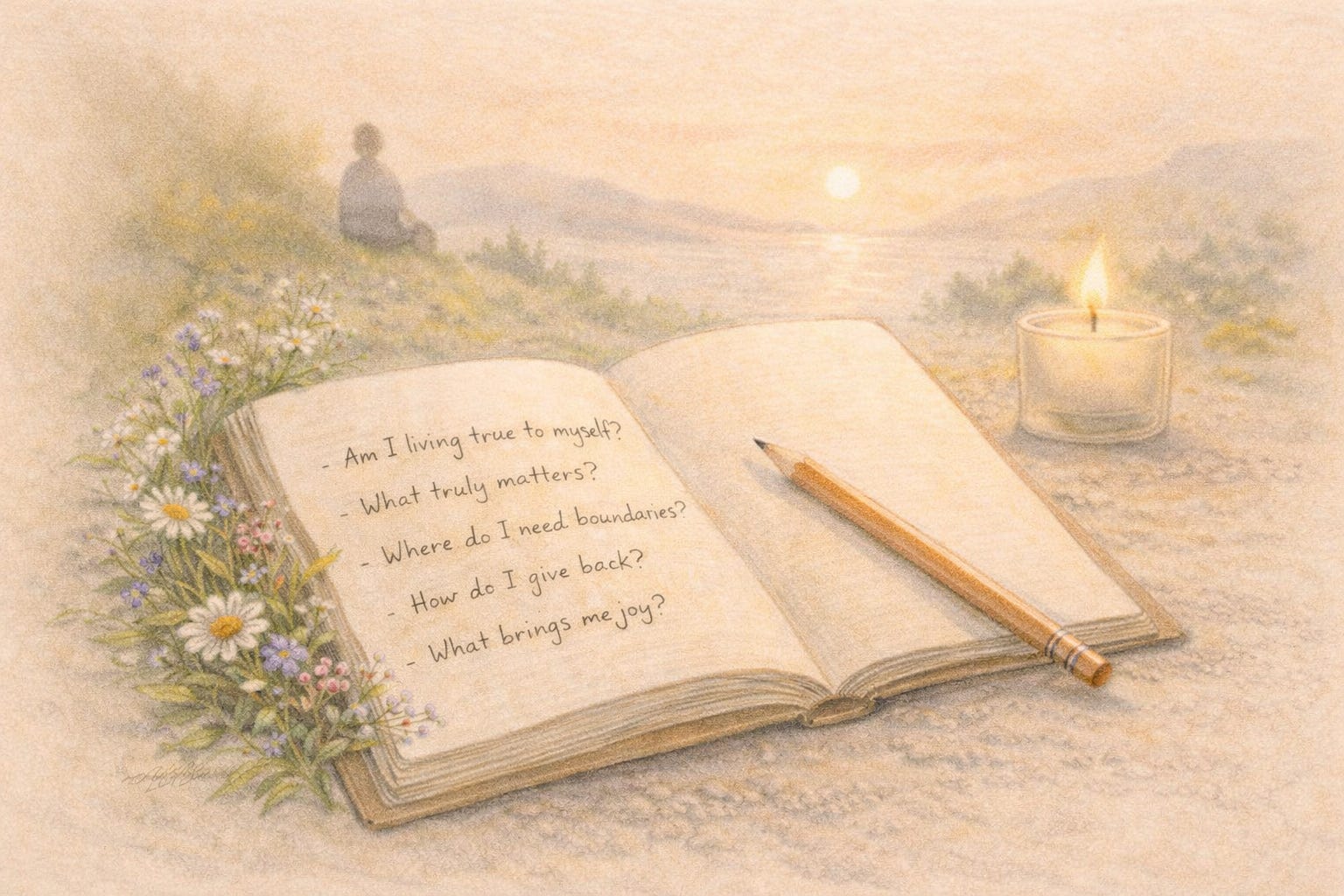
Every now and then, it’s worth pausing long enough to ask yourself a few honest questions as a quiet check-in.
Life has a way of gathering momentum. Days roll into weeks, weeks into months, and before long you realise a lot has happened without you fully stopping to look at it. The routines kept going. Decisions were made. Some things grew. Other things stayed exactly the same.
And if we’re honest, most of the time we don’t step back to examine any of it.
But a year is a long enough stretch of time to reveal patterns. Long enough to see where we’ve changed, where we’ve stayed stuck, and where life has slowly nudged us in directions we didn’t fully notice at the time.
So once a year or so, we believe it’s good to focus on a handful of questions. Not because they produce perfect answers. They rarely do. But they create a moment of clarity - the kind that helps you look at your life with fresh eyes for a minute.
Over time we’ve found that a few simple questions, asked honestly, can reveal more than an entire notebook full of goals.
Alexandra Pasareanu founder of Wisdom Library and Patel Akshet founder of A-broad Perspective share their experience with 5 main questions and they will show how life is worth revisiting every year.
1. Am I Living By Design - Or By Default?
This question can be uncomfortable, which is probably why it’s useful.
For a long time, if I am honest, I was living by default.
I woke up, went to work, followed routines, said yes to things, stayed busy. On the surface everything looked fine. But something inside me quietly knew I was mostly on autopilot. Life was happening, but I was not really steering it.
Then few years ago something shifted. More like a quiet decision I kept repeating to myself: I need to take charge of my own life.
So I slowly switched the autopilot off.
I started asking myself what actually makes my life meaningful. Not what looks good, not what others expect, but what truly matters to me. That led to a lot of small but important changes.
I redirected my passions. I reshaped my habits. I made space again for hobbies that make me feel alive instead of just busy.
One of the hardest things was building the courage to say “no”. For years I carried this unnecessary guilt when I declined something. As if protecting my own time meant I was disappointing someone. But eventually I understood that saying no is not selfish. Sometimes it is simply honest.
I began prioritising quiet mornings. Those calm hours before the day becomes noisy. And I started creating slower evenings too - more reflection, more stillness, sometimes just sitting quietly instead of filling every moment.
I also became more selective with the people I keep close. Not in a harsh way, but in an intentional way. Some friendships naturally stayed strong. Others slowly drifted away. And that is okay.
Perhaps the biggest shift was removing clutter from my life. Not only physical clutter, but emotional and mental clutter too. I began cleaning things up intentionally, one piece at a time.
Looking back, that year felt like opening a window after a long time in a closed room.
Fresh air finally came in.
Living by design doesn’t mean controlling everything. That’s impossible. But it does mean asking, at least occasionally: Is this actually the life I want to be building?
Sometimes the answer is yes. And that’s reassuring.
Other times the answer is… not quite. And that’s where the course correction should begin.
Most of us think we are choosing our lives.
But often, we are simply continuing them.
We wake up, follow the same routines, respond to the same expectations, and convince ourselves that momentum is the same as intention.
Living by design requires something uncomfortable: awareness.
It asks you to pause and question the path you are on.
Why am I doing this?
Is this what I truly want, or just what I got used to or what I was forced into?
Sometimes you realise parts of your life were chosen for you by circumstance, by fear, or by convenience.
And that is okay.
But the moment you notice it, you gain the power to choose again.
Design begins the moment you stop floating through life.
2. Who Am I Becoming?
We tend to measure life by milestones. Career steps. Income. Achievements. Goals reached.
But those things only tell part of the story. The deeper question is about identity.
A while ago I did something simple but surprisingly powerful. I looked back at who I was 5 years ago and compared that person to who I am today.
Not in a judgmental way. Just a quiet review.
And honestly, I noticed something that made me smile.
I have become more mature. A little wiser. Definitely more aware of myself and of life.
The way I deal with stress has changed. In the past, small setbacks could feel overwhelming. A difficult day at work or an unexpected problem would stay in my mind for hours.
Now I pause more. I breathe. I remind myself that most problems are temporary.
Life still throws its bumps in the road, of course. That part never changes. But I handle them differently. I look at the glass half-full far more often than I used to.
Another change surprised me. I have become more comfortable admitting when I am wrong.
Before, I sometimes felt the need to explain or defend myself. Now I find it much easier to simply say, You are right. I made a mistake. And honestly, it feels lighter that way.
Sometimes I catch my reflection in the mirror and I think quietly, I like the person I am becoming.
Not because everything is perfect. Far from it. But because I know I am listening and growing.
It’s subtle, but it matters. Every year asks the same quiet question: Are you becoming someone you respect?
We often measure life by what we achieve.
But the deeper question is who we are becoming along the way.
Success can build you.
But it can also slowly change you in ways you never intended.
The pressure, the pace, the expectations; they shape your character over time.
So the question is not just whether you are moving forward.
It is whether you like the person you are turning into.
Are you becoming more patient?
More kind?
More grounded?
Or simply busier?
Growth is not only about progress.
It is about alignment with the person you want to be.
3. What Am I Tolerating That I Shouldn’t Be?
This one requires honesty.
This one hit me quite hard when I first asked it.
For years I had a habit of saying “yes” too quickly. Yes to help someone. Yes to avoid disappointing someone. Yes because I wanted to be seen as kind, supportive, agreeable.
And while I was doing all that, I slowly forgot about myself.
It took a bit of honest reflection to realise how often I was stretching myself just to keep others comfortable. I was protecting everyone else’s feelings while quietly ignoring my own limits.
During my self-review, something became very clear to me.
Life is not about pleasing everyone. It is about having the courage to be yourself, even when that means going against what others expect.
You should not apologise for who you are or for the choices that keep you healthy and balanced.
The people who truly care about you will understand. And those who do not understand - well, their opinion does not need to define your life.
Another thing I learned is that holding on to people who do not support you slowly drains your spirit. Life is too short for relationships that take more than they give.
So I stopped tolerating a few things.
I became kinder to myself. I listened to my own needs more carefully. And I started choosing what truly makes me happy instead of constantly trying to satisfy everyone around me.
In the end, your happiness is your responsibility.
No one else can carry that for you.
Not everything can be fixed overnight. Life rarely works like that.
But naming what shouldn’t be tolerated anymore is often the first real step toward changing it.
Tolerance creeps up silently.
It does not always feel obvious.
It looks like staying in environments that drain you.
Accepting behaviour that slowly chips away at your self-respect.
Delaying decisions you already know the answer to.
We tolerate things because change feels harder.
But over time, tolerance becomes a silent agreement with what no longer serves us.
And the cost is subtle but real.
Energy.
Peace of mind.
Confidence.
Sometimes growth is not about adding something new.
Sometimes it is simply about deciding what you will no longer accept.
4. Where Did I Grow - And Where Did I Hide?
Growth rarely feels comfortable while it’s happening.
It usually looks like awkward attempts, uncertain steps, or doing something that scares you just enough to make your heart beat faster.
One of the biggest ways I have grown is through understanding people better.
For a long time I believed that if someone hurt me, it must have been intentional. That they should have known better.
But life slowly taught me something important.
Not everyone sees the world through the same lens I do.
People carry different life experiences, different childhoods, different lessons, different emotional tools. What feels obvious to me may not be obvious to someone else at all.
When someone reacts poorly or behaves in a way that feels hurtful, it is not always done with bad intentions. Often it simply reflects the level of awareness or emotional skills they had in that moment.
Realising this changed how I respond to people.
I became more patient. More understanding. Less quick to assume the worst.
At the same time, I also grew in another direction - learning to take better care of myself.
I started listening to my own inner voice more carefully. Paying attention to how situations actually make me feel. Being present in the moment instead of constantly rushing through life.
But there is another side to this question too.
As I mentioned above, for a long time, I hid my voice. Especially my nos. But slowly, gently, I stopped hiding. I started expressing my thoughts more honestly. I allowed my boundaries to exist without apology.
And that, in its own quiet way, felt like real growth.
Growth is not always visible.
It does not always come in big milestones or clear victories.
Sometimes growth is quieter.
It is the moment you handled something with more patience than before.
The time you chose honesty instead of comfort.
The decision to try again after failing.
But honesty also requires acknowledging where we hid.
The risks we avoided.
The conversations we postponed.
The opportunities we convinced ourselves we were not ready for.
Both are part of the story.
Growth shows you your strength.
Hiding shows you where courage is still waiting.
5. If This Year Were My Last, What Would Matter Most?
This question can sound dramatic at first, but it has a way of clarifying things quickly.
Sometimes I imagine this question very literally.
If this year were my last year on Earth, how would I spend it?
The answer appears almost immediately.
I would spend far more time with my family and friends. Real time. Unrushed conversations. Long dinners. Walks. Laughter.
I would probably leave the corporate world behind and focus more on creating. Writing, building ideas, exploring the things that make my mind curious.
I would meditate more. Travel more. Experience places slowly instead of always rushing back to schedules and obligations.
Most of all, I think I would feel free.
Free from constant worries. Free from overplanning every step. Free from the invisible pressure of systems that often make us feel like we are running in circles.
Sometimes it feels like modern life quietly keeps us in chains. Expectations, routines, deadlines, responsibilities.
If this were my last year, I think I would loosen those chains and simply live.
Not recklessly. Just honestly.
And maybe that thought is the real gift of this question.
It reminds me that even if this is not my last year, I can still choose to live with a little more freedom than yesterday.
And while I obviously don’t live as if every year is my last, this question reminds me of something simple but easy to forget:
Time is limited.
The real challenge is living in a way that reflects that truth while we still have it.
This question has a way of cutting through the noise.
Suddenly, the small worries lose their importance.
You realise it would not be about more emails answered, more tasks completed, or more approvals gained.
It would be about the people you loved.
The conversations you had.
The memories you created.
The moments where you were truly present.
It would be about whether you lived honestly.
Whether you were kind.
Whether you allowed yourself to experience life instead of constantly postponing it.
A Quiet Invitation
These questions aren’t meant to produce perfect answers.
In fact, the answers will change every year. That’s the point.
The real value is in the pause they create. A moment to step slightly outside the momentum of daily life and look around.
To check the direction.
To adjust a few things.
To remember what matters.
Honestly, that small pause might be one of the most valuable habits we can build.
Life doesn’t usually transform in one dramatic moment. It shifts through small corrections made over time.
And sometimes, all it takes to begin that shift is a good question asked at the right moment.
Now it’s your turn to sit with these questions for a while and see what they reveal about your own life.
Thank you for reading and reflecting alongside us. Alexandra Pasareanu and Patel Akshet
If you found this article meaningful or useful, I’d truly appreciate it if you could share it. It helps to spread more wisdom in the world.
I love this. Reading it made me realize that I’ve been doing a version of this periodically without even realizing it, just pausing for self-reflection and quietly checking in with myself.
But I really appreciate the idea of consciously asking these five questions and truly sitting with the answers. That kind of intentional pause can reveal a lot.
It also makes me think how valuable it would be if something like this were taught in school. Learning how to reflect on our lives, our choices, and who we’re becoming might be one of the most important life skills there is.