

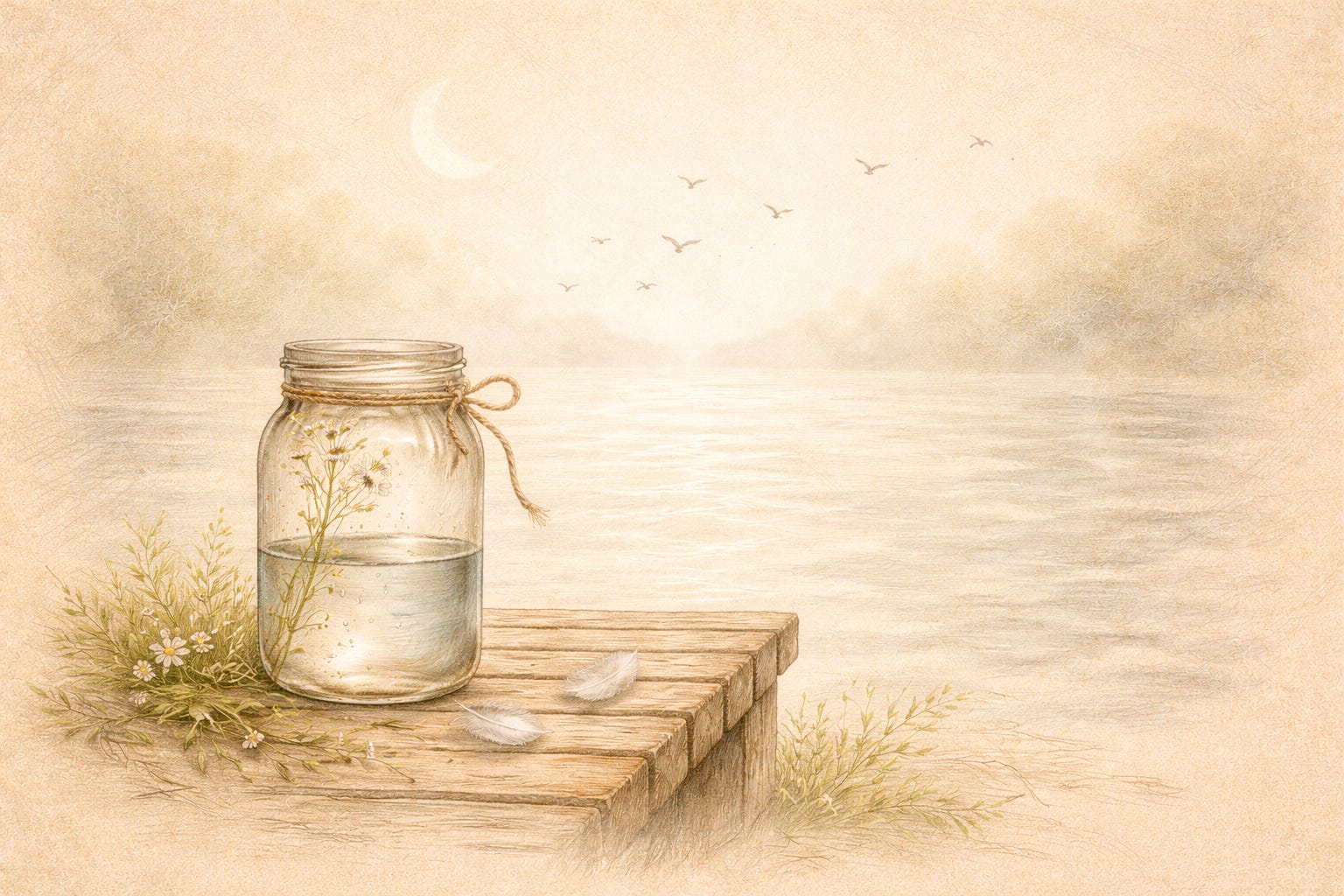
I used to think peace only arrived once things were finished.
Once the conversation wrapped neatly.
Once the project was done.
Once the relationship made sense in a way I could explain without pausing or backtracking.
I chased closure like it was oxygen. Loose ends felt dangerous, like proof that I had failed to handle something properly. If something stayed unresolved, I assumed I had missed my chance to do it right.
Honestly, I thought peace was something you earned by tying everything up.
So when I went searching for how to feel calm in my life, the answer always sounded the same: finish more things. Decide faster. Solve the problem. Close the chapter. I built mental checklists and emotional timelines, convinced that once everything was settled, I would finally relax.
To be fair, that belief is comforting. It gives you a sense of control. But it also sets you up for constant disappointment.
Because life does not move in straight lines. It does not always explain itself. And it rarely offers clean endings on demand.
There are still parts of my life that feel unfinished. Conversations that faded instead of ending. Friendships caught in a quiet in-between. Creative work that paused mid-journey, not abandoned, just waiting. Questions that never got answers, no matter how long I sat with them.
For a long time, those things felt like emotional clutter. Like boxes stacked in a room I pretended not to see. I wanted everything resolved. Fixed. Finished. I thought that was what being emotionally healthy looked like.
But sitting with unfinished things is uncomfortable for a reason. It challenges our sense of identity and self-worth. We crave completion because it feels safe. It gives the story a shape we can hold onto.
Here’s the thing: real life does not live at the edges. It lives in the middle.
And slowly, without any dramatic breakthrough, my relationship with uncertainty began to change.
How Letting Go Of Control Changes Everything
At some point, I realized my discomfort was not about productivity or resolution. It was about control.
If something was unfinished, I could not predict the outcome. I could not label it a success or a failure. I could not file it away. And that uncertainty made me uneasy in a way I had never fully acknowledged.
Unfinished meant open. Open meant vulnerable.
But life does not follow tidy timelines. Some things stay incomplete not because they are broken, but because they are still unfolding. Others remain unresolved because they were never meant to end the way we imagined.
And some things are simply ambiguous. No lesson. No bow. Just real.
When I stopped fighting that truth, something softened. I began to see that not knowing how something turns out does not strip it of meaning. In many cases, it deepens it.
That shift changed how I approach relationships, career decisions, and creative work. I stopped demanding guarantees before moving forward. I stopped treating uncertainty like a problem that needed solving.
I started asking a different question: What if I could be at peace even without closure?
What if the open-ended parts of my life were not mistakes, but spaces I had not grown into yet?
In a world obsessed with clarity and quick answers, learning to sit with uncertainty stopped feeling optional. It felt necessary.
Living Gently With The Unfinished
If you are carrying unresolved pieces of your own, you are not behind. You are human. We all live with questions that refuse to settle.
Here are a few ideas that helped me loosen my grip without losing myself.
Let Go Of The Fix-It Reflex
Not everything unfinished is broken. And not everything broken needs immediate repair.
When something feels unresolved, our instinct is to rush in with solutions. To overthink. To replay conversations. To push for answers. But sometimes the healthiest response is pause.
If you feel stuck looping, try asking: What if this does not need fixing right now? What if being with it is enough?
Acceptance is not giving up. It is choosing not to exhaust yourself fighting reality.
Trust The In-Between
That grey space where nothing is clear - the pause in a relationship, the dream that went quiet, the question that keeps returning - is uncomfortable for a reason. It is alive.
Living with unfinished business is not a weakness. It often means you are evolving. When you stop treating the in-between as wasted time, it becomes fertile ground.
You learn that you can still show up, still love, still create, even without certainty. That realization builds resilience in a way answers never could.
Redefine What Completion Means
Completion does not always look like a final conversation or a clear ending. Sometimes it is internal.
Maybe you learned something. Maybe you became more honest. Maybe you outgrew the version of yourself that needed a different outcome.
That counts.
In personal growth, closure often comes from integration, not resolution. Especially when it comes to emotional healing. You do not always need the outside world to finish the story for you.
Make Peace A Practice
Peace does not only arrive after everything is settled. Sometimes it shows up when you stop waiting for the ending.
Learning how to be okay with not knowing is a daily practice. Small moments of presence. Breathing instead of spiraling. Letting today be enough, even if tomorrow is unclear.
Slow walks. Journaling without fixing the page. Sitting quietly with a feeling instead of rushing past it. These are reminders that peace lives in the present, not the conclusion.
Let The Questions Stay Open
Some questions shape us more than their answers ever could.
Let yourself live into them. Trust that clarity may come later, or that it may arrive as growth rather than explanation. Sometimes the answer is not a sentence. It is who you become while waiting.
Accepting unanswered questions is not weakness. It is emotional maturity.

Why This Matters More Than We Think
We are taught to chase certainty, but life offers something richer if we let it. Depth. Mystery. A slow unfolding that cannot be rushed.
When you stop demanding immediate clarity, you give yourself permission to grow at your own pace. You release the pressure to have everything figured out. You make room for compassion, especially toward yourself.
This is not about giving up. It is about sustainability. Learning to live with uncertainty builds adaptability and inner strength. It teaches you that you are capable, even when the map is blurry.
When you learn to be okay with not knowing, you begin to trust yourself more. You realize you do not need all the answers to keep going. You can live well inside the open chapters.
A Thought To Carry With You
“You do not have to know precisely what is happening, or exactly where it is all going. What you need is to recognize the possibilities and challenges offered by the present moment, and to embrace them with courage, faith, and hope.” - Thomas Merton
Before you move on, pause for a moment.
What part of your life feels incomplete right now, but might not need resolution yet?
What if you let it stay open without calling it a failure?
This week, write down one area of uncertainty. Then list three ways not having it resolved might be serving you - quietly creating space, protecting you, or teaching patience.
You might discover that the unknown is not an enemy.
Sometimes, it is an invitation.
If this article meant something to you, buying me a coffee is a simple way to support my work. Every contribution helps Wisdom Library continue to grow. Thank you for being here. 💛
This resonates deeply with me. You articulated something many of us feel but rarely allow ourselves to accept: that peace does not come from finishing everything, but from forgoing the need to control how things end.
Insightfully articulated .. with depth and clarity.
Thank you
🙏🙏